The short answer
Austin leaks are found by confirming loss at the meter, isolating the yard line, then pinpointing with pressure tests, acoustic listening, thermal imaging or a crawlspace inspection. The Balcones Fault divide between clay and limestone, older central bungalows and a large rental market are the local factors.
Leak problems Austin property owners run into
The Balcones Fault runs roughly along MoPac and I-35 through Austin. To the west, the Hill Country has shallow, rocky soil over limestone. To the east, the Blackland Prairie has deep, expansive clay. Census estimates show renters occupy more than half of homes, and the city’s housing ranges from 1920s bungalows to new towers.
Leak situations split along that line:
- East side clay. Slabs move with wet and dry seasons, stressing under-slab lines.
- West side rock. Foundations on limestone move less, but digging to a buried leak is slow and expensive, so pinpointing matters.
- Central bungalows. Pier-and-beam homes have crawlspace plumbing, often a patchwork of old and new pipe.
- Freeze and ice. The February 2021 winter storm burst pipes across the city, and lines in attics, crawlspaces and exterior walls remain the most exposed.
Warning signs Austin owners notice first
- Warm patches on tile floors.
- Water seeping out of a limestone ledge in a west-side yard in dry weather.
- Damp spots where a line crosses rock and the soil is thin.
- The meter moving with everything inside and outside turned off.
- A well pump or pressure tank running when nobody is using water.
- A musty smell from the crawl vents of a central Austin bungalow.
Pair any of these with a meter check before assuming the worst.
Which leak detection services fit Austin homes
The statewide guides explain each method in depth. Here’s why each one matters in Austin.
- Slab Leak Detection in AustinEast of MoPac, most Austin homes sit on expansive Blackland clay that moves slabs and under-slab plumbing every season.
- Crawlspace Leak Detection in AustinCentral neighborhoods such as Hyde Park, Travis Heights and Clarksville have many older pier-and-beam bungalows.
- Ceiling and Wall Leak Detection in AustinMore than half of households rent, and stacked condos and apartments see leaks pass between units.
Something else going on? Emergency leak steps and the general leak guide cover the rest.
How a provider finds the leak in Austin
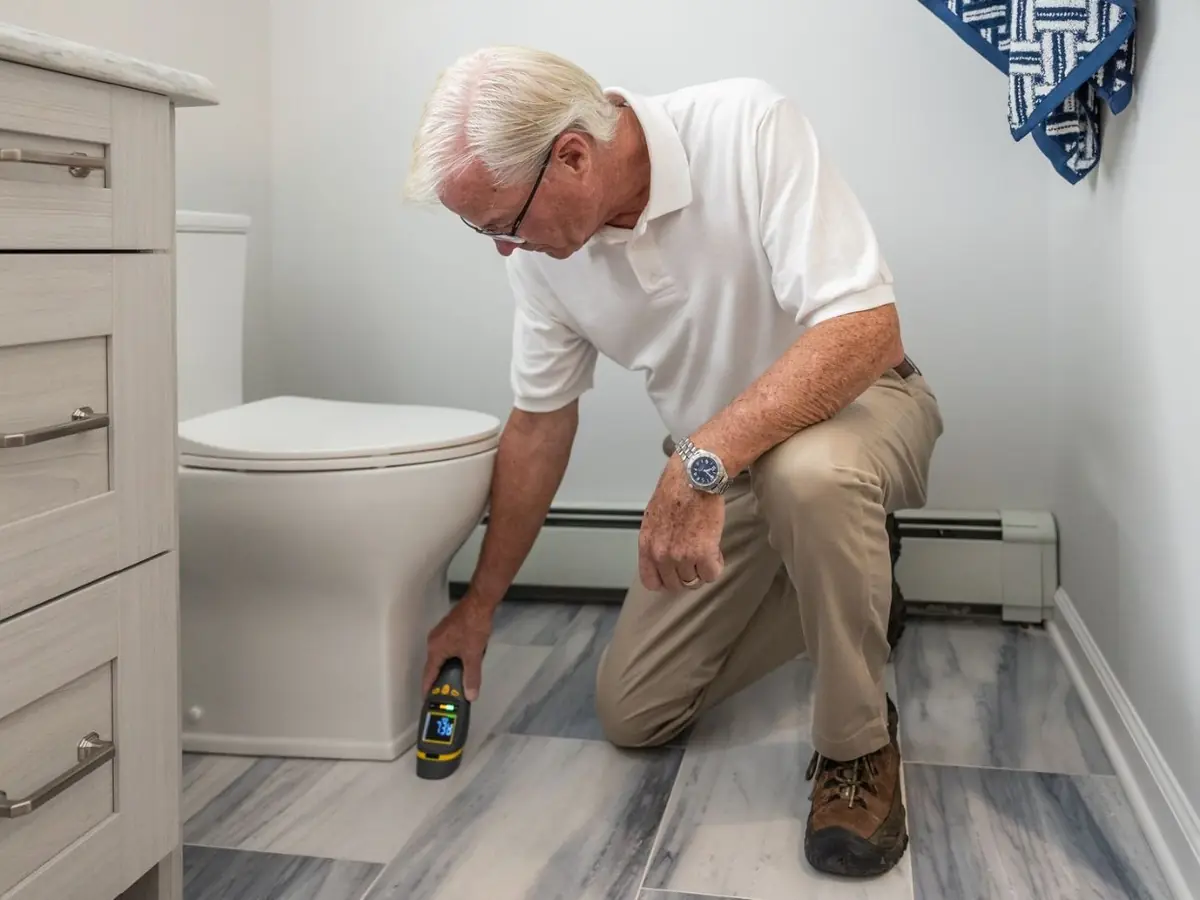
- Confirm the loss. The provider watches the meter with every tap closed and the water heater valve noted.
- Pressure-test sections. Hot, cold and the yard line are tested separately to find which one won’t hold pressure.
- Check the warm spots. On hot-line leaks, a thermal camera often shows the warm trail across tile or concrete.
- Pinpoint acoustically. Listening points are taken across the floor until the sound peaks over the leak.
- Talk through the repair. Breaking out the floor is one option. Rerouting the line overhead often avoids it.
Austin providers often ask which side of town a property is on, because clay and limestone change both the likely leak and the cost of reaching it.
Want a professional to look at it? Call to request leak detection help in Austin and talk through what you're seeing.
Call 1-866-297-0573Service coverage around Austin
Calls about Austin properties are routed to a leak detection provider serving that address, when one is available. Austin Water bills most addresses inside the city. Some surrounding areas are served by MUDs or water supply corporations.
Nearby communities include:
- Round Rock
- Pflugerville
- Cedar Park
- West Lake Hills
- Sunset Valley
- Manor
- Buda
Austin ZIP codes
These ZIP codes are used for Austin street addresses. ZIP 73301 and 73344 and 78772 and 78773 and 78774 and 78778 and 78779 and 78783 are unique ZIPs assigned to a single organization rather than to neighborhoods.
- 78681
- 78701
- 78702
- 78703
- 78704
- 78705
- 78710
- 78712
- 78717
- 78719
- 78721
- 78722
- 78723
- 78724
- 78725
- 78726
- 78727
- 78728
- 78729
- 78730
- 78731
- 78732
- 78733
- 78734
- 78735
- 78736
- 78737
- 78738
- 78739
- 78741
- 78742
- 78744
- 78745
- 78746
- 78747
- 78748
- 78749
- 78750
- 78751
- 78752
- 78753
- 78754
- 78756
- 78757
- 78758
- 78759
- 78799
PO Box ZIP codes 78708, 78709, 78711, 78713, 78714, 78715, 78716, 78718, 78720, 78755, 78760, 78761, 78762, 78763, 78764, 78765, 78766, 78767 and 78768 also belong to Austin but have no street addresses, so they aren’t service locations on their own.
Related guides for the Austin area
Close by, with their own local notes:
- Water leak detection in Round Rock, TXWilliamson County, north of Austin. Limestone to the west, Blackland clay to the east, and mostly 1990s–2000s homes.
- Water leak detection in Pflugerville, TXTravis County, northeast of Austin. Mostly 1990s–2000s single-family slab homes on Blackland clay.
- Water leak detection in Cedar Park, TXWilliamson and Travis counties. Newer slab homes on thin soil over Hill Country limestone.
- Water leak detection in Kyle, TXHays County, between Austin and San Marcos. One of the youngest housing stocks in Texas, mostly on Blackland clay.
- Water leak detection in San Marcos, TXHays County seat, home to Texas State University. A renter-majority city on the Balcones Escarpment with a serious flood history.
- All Austin and the I-35 Corridor citiesEvery city in this region with its own page.
Austin leak detection FAQ
Does it matter if I’m east or west of MoPac?
It can. Clay to the east moves foundations and pipe more. Limestone to the west makes digging harder. Both affect the repair plan.
My central Austin bungalow is pier-and-beam. How are leaks found?
Usually by inspecting the crawlspace and confirming with pressure tests. Repairs are often made from below.
Did the 2021 freeze damage my pipes?
It burst pipes across the city, and some stressed pipes failed later. Testing shows whether you have a leak now.
Who handles leaks at the street?
Contact Austin Water or the utility named on your bill for anything on its side of the meter.
Sources for the local details on this page
ZIP codes and housing-age figures come from the public sources above. Soil, climate and housing notes reflect widely published regional information. Utility policies change, so confirm anything about billing or responsibility with your own water provider.