The short answer
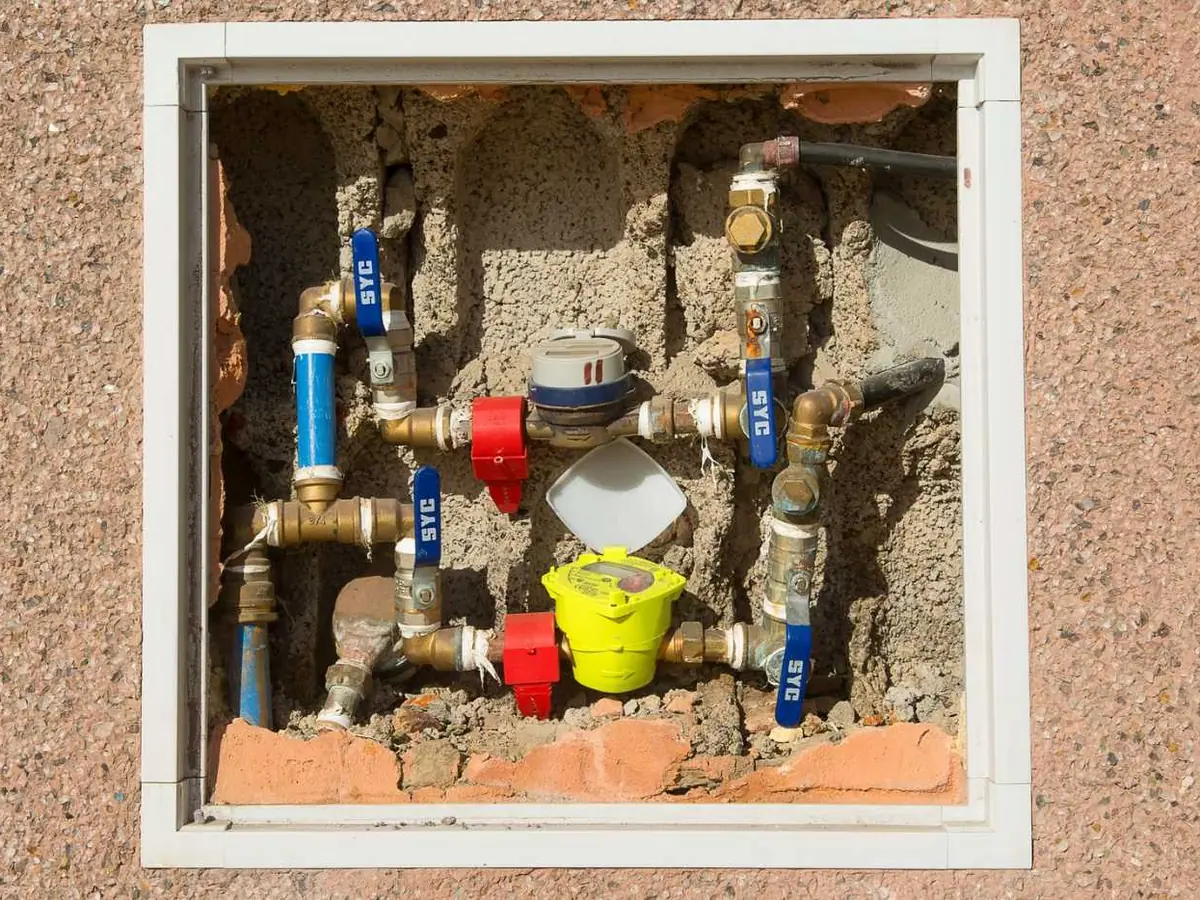
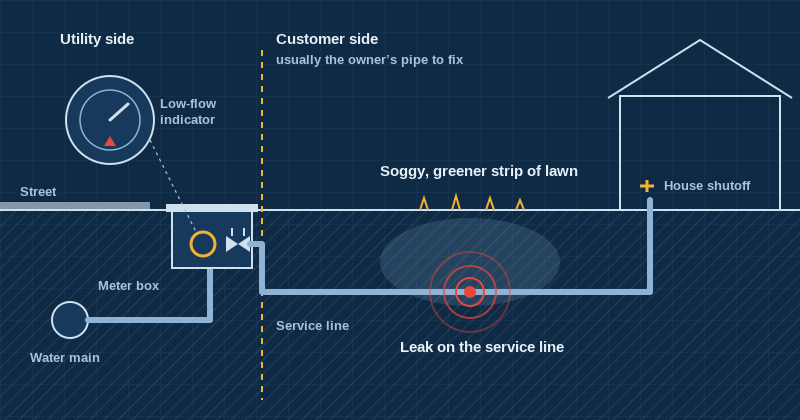
Water meter leak detection uses the meter to confirm whether water is being lost when nothing is running, then isolates parts of the system to narrow down where it’s going. If the meter’s low-flow indicator moves with every fixture off, there’s a leak somewhere between the meter and your fixtures. Closing the house shutoff tells you whether it’s in the buried service line or inside the house.
What a meter-based investigation detects
Every drop of water your property uses passes through the meter. That makes it the starting point for any leak search. A meter test can tell you:
- Whether you have a leak at all, as opposed to a billing problem or higher use.
- Roughly how much water is being lost, by comparing readings over a set time.
- Which side of the house shutoff the leak is on, by closing that valve and watching the meter.
- Whether a leak is constant or intermittent, by testing more than once.
Many meters have a small low-flow indicator, often a triangle, star or small dial, that spins with even a slight flow. Some newer meters are digital and show a flow rate or flow symbol instead. Your water provider can explain the display on your model.
Why is my water bill so high?
A high bill has only a few possible explanations: more water was used on purpose, water is leaking, or the bill itself is off. Work through them in this order.
- Check the bill. Was it an estimated read? Is the billing period longer than usual? Did rates change?
- Think about use. Guests, a new pool, filling a hot tub, summer irrigation or a new lawn all raise use quickly.
- Check the toilets. A worn flapper can run silently for weeks. Put a few drops of food coloring in the tank, wait 15 minutes without flushing and look for color in the bowl.
- Check irrigation. A broken head, stuck valve or controller set to run too often can use far more water than a household.
- Check appliances. Water softeners stuck in regeneration, ice makers, and evaporative coolers are frequent offenders.
- Do the meter test. If the meter moves with all of the above off, the leak is in the plumbing itself.
A bill that jumps once and returns to normal often points to an event, such as a running toilet that was fixed. A bill that rises and stays up points to an ongoing leak.
Signs your meter is telling you something
- The low-flow indicator moves with every fixture, appliance and irrigation zone off.
- The meter reading changes over one or two hours of no use.
- Water use on your bill is higher than the same month last year with no change in habits.
- You can hear water flowing at the meter box.
- The meter box is full of water when it hasn’t rained.
What causes leaks the meter picks up
Anything on the customer side of the meter can show up in a meter test: running toilets and dripping fixtures, irrigation leaks, service line leaks, slab leaks, leaks in walls and ceilings, water heater relief valves discharging, and appliances such as softeners and ice makers. Leaks on the utility side of the meter usually don’t register on your meter, which is one reason a wet meter box needs a closer look.
How to do a meter test
- Turn everything off. Every faucet, toilet, shower, washer, dishwasher, ice maker, softener, evaporative cooler and irrigation zone.
- Find the meter. In most Texas neighborhoods it’s in a box near the street or front property line. Lift the lid carefully and watch for insects and snakes.
- Watch the low-flow indicator for a few minutes. Any movement means water is flowing.
- Take a reading, wait one to two hours without using water, then read again. Any change means a leak.
- Close the house shutoff and watch the meter again. If it still moves, the leak is likely between the meter and the house. If it stops, the leak is inside the house or on a line that branches off after the shutoff.
If the meter test confirms a leak and the obvious fixtures check out, a professional takes it from there with pressure testing and pinpointing equipment.
What happens during a professional investigation
A provider starts where you left off. They’ll verify the meter readings, check the house shutoff actually closes fully, and isolate the service line, irrigation, hot side and cold side one at a time. Whichever section loses pressure is scanned with listening equipment, thermal imaging or tracer gas until the leak is pinpointed. If the meter still moves with the house fully isolated, the focus shifts to the service line.
Why early detection matters
Water lost at the meter is paid for whether you use it or not, and a steady leak shows up on every bill until it’s found. Beyond cost, a leak in the service line can soften soil near the foundation, and a leak inside the house can do damage long before you see it.
Some Texas water providers offer a leak adjustment on a bill after a qualifying leak is repaired, usually with a repair invoice as proof. Policies differ by provider, so ask yours what they need.
What a meter investigation may cost
The meter test you do yourself costs nothing. Professional detection is priced by each provider. Cost depends on how many sections need testing, whether the leak turns out to be in the service line, under the slab or in a wall, and which pinpointing methods are needed. Ask what the visit includes before booking.
When to call
Call when the meter test shows movement with everything off and you’ve ruled out toilets, irrigation and appliances. Call right away if the meter is spinning fast, the meter box is flooding, or water is surfacing in the yard or house.
If the leak looks like it’s on the utility side, before the meter, contact your water provider instead.
Frequently asked questions
Where is my water meter?
In most Texas homes it’s in a box at ground level near the street, sidewalk or front property line. On rural or larger properties it may be farther from the house. Your water bill or provider can tell you if you can’t find it.
What does the little triangle on my meter mean?
That’s the low-flow indicator. It spins with very small amounts of flow, so it’s the fastest way to see whether water is moving when nothing should be.
Can a water meter be wrong?
It’s possible but less common than a leak. If you’ve confirmed no leak and the bill still seems wrong, ask your water provider to re-read or test the meter.
Who’s responsible for a leak at the meter?
Many Texas providers handle the meter and pipe on the street side, and the owner handles the pipe from the meter to the house. Arrangements differ, so confirm with your provider.
Why is my meter box full of water?
It may be rainwater, a leak at the meter connection or a leak in a nearby line. Report it to your water provider if the water is coming from their side.
My bill doubled. Is that definitely a leak?
Not definitely. Check for an estimated read, a longer billing period and irrigation changes first. If the meter moves with everything off, it’s a leak.
Do I need to shut off my water before a provider arrives?
Not unless water is actively causing damage. Keeping use to a minimum for an hour or so before the visit helps the meter readings.
Can I get money back on my bill after a leak?
Some providers offer leak adjustments after a repair. Keep the repair invoice and ask your provider about their policy.
Local water meter leak detection guides
- Water Meter Leak Detection in Bryan, TXSorting a real leak from summer watering and billing questions with the meter.
Where water meter leak detection comes up most in Texas
These city pages explain why water meter leak detection matters locally, from soil and housing age to how water is supplied. Open a region to see its cities, or browse every service area.
Dallas–Fort Worth Metroplex (35)
- Garland, TXA sudden bill jump is often the first clue in a home where the leak itself is hidden under concrete.
- Mesquite, TXHomeowners here often notice a leak first as a bill that doesn’t match their habits.
- Carrollton, TXWith so many homes on irrigation, separating sprinkler use from a real leak is a common first question.
- Grand Prairie, TXA bill that doesn’t match the household is a common first sign in a city with this much irrigation.
- Duncanville, TXWith leaks hidden under concrete, a rising bill is frequently the first warning.
- DeSoto, TXLarge irrigated lawns make it important to separate sprinkler use from a true leak.
- Balch Springs, TXFor many households here, a higher-than-usual bill is the first sign that water is going somewhere.
- Rowlett, TXWith large lawns and pools common, a bill spike needs sorting out before anything is opened.
- Sachse, TXNewer homes with large irrigation systems often show a leak first as a bill that doesn’t make sense.
- Coppell, TXLarge irrigated lots make high-bill investigations a common starting point.
- Plano, TXBig irrigated lawns make it important to separate sprinkler use from a real leak before testing the house.
- Frisco, TXIn a city of newer homes and large irrigation systems, a confusing bill is the most common way leaks get noticed.
- McKinney, TXWith large irrigated lots in newer areas, separating sprinkler use from a leak is the usual first step.
- Allen, TXWith large irrigated yards across the city, bill spikes need sorting out before anything is opened.
- Prosper, TXWith new homes and big lawns, a bill that doesn’t make sense is usually the first warning.
- Murphy, TXIn a suburb of newer homes with irrigation, a bill spike is the usual first clue.
- Wylie, TXWith newer homes and large lawns, unexplained bills are the most common first sign.
- Little Elm, TXWith nearly all-new housing, bills are often the only sign of a hidden leak.
- The Colony, TXWith housing of every age, the bill is often the first clue that something has changed.
- Flower Mound, TXBig lawns mean big irrigation systems, so separating sprinkler use from a leak comes first.
- Corinth, TXIrrigation and a mostly owner-occupied housing stock make bill investigations a common starting point.
- Rockwall, TXWith newer homes and big lawns, the bill is often the first sign of trouble.
- Forney, TXIn a city of new homes with irrigation, an unexplained bill is the usual first clue.
- Arlington, TXA large share of households notice leaks first as a bill that doesn’t match their habits.
- North Richland Hills, TXWith irrigated lawns across the city, separating sprinkler use from a real leak comes first.
- Saginaw, TXIn a city of mostly newer homes with irrigation, the bill is often the first warning.
- Mansfield, TXLarge lots and irrigation make bill investigations a common starting point.
- Hurst, TXWith leaks hidden under concrete and yards, the bill is often the first warning.
- Watauga, TXFor most owners, a rising bill is the first sign of a hidden leak.
- Burleson, TXWith many newer homes on irrigated lots, unexplained bills are the most common first clue.
- Keller, TXBig lawns and irrigation systems make bill investigations a common starting point.
- Southlake, TXIrrigation dominates water use here, so separating it from a true leak comes first.
- Colleyville, TXWith big lawns, sorting out irrigation use from a real leak is the usual first step.
- Midlothian, TXWith many newer homes and big yards, unexplained bills are a common first sign.
- Waxahachie, TXWith a mix of old and new homes, the bill is often the first clue for either kind of leak.
Greater Houston and the Upper Gulf Coast (8)
- Pearland, TXWith newer homes and irrigation, a bill that doesn’t make sense is a common first sign.
- Fresno, TXWith newer homes and irrigation, the bill is often the first clue to a hidden leak.
- League City, TXWith large irrigated lots in master-planned neighborhoods, bill investigations are a common starting point.
- Missouri City, TXWith many irrigated lots, separating sprinkler use from a real leak comes first.
- Sugar Land, TXLarge irrigated lots and HOA landscaping standards make irrigation a top suspect for high bills.
- Spring, TXWith irrigation and large lots common, separating sprinkler use from leaks comes first.
- Friendswood, TXWith large irrigated lots, bill investigations are a common first step.
- Katy, TXBig irrigated lots in master-planned communities make bill investigations a common first step.
South Texas Gulf Coast (2)
- Corpus Christi, TXWith water conservation a recurring issue here, catching hidden loss on the meter matters more than in most cities.
- Kingsville, TXWith hot, dry summers and many rentals, an unexplained bill is often the first clue.
Central Texas and the Brazos Valley (5)
- Killeen, TXWith so many military families moving in and out, leaks often surface as a bill between tenants or owners.
- Harker Heights, TXWith military families and frequent moves, a bill is often the first sign.
- Copperas Cove, TXWith frequent military moves, leaks often surface as an unexpected bill.
- Fort Hood, TXFrequent PCS moves mean leaks often surface as an unexpected bill at a new address.
- College Station, TXStudent turnover means leaks often show up first as a bill nobody expected.
Austin and the I-35 Corridor (8)
- Round Rock, TXLarge irrigated lots and watering schedules make bill investigations a common first step.
- Cedar Park, TXWith irrigation and watering restrictions common, the bill is often the first warning.
- Leander, TXIn a city of brand-new homes, a confusing bill is usually the first sign of a leak.
- Pflugerville, TXWith irrigated lots everywhere, separating sprinkler use from a leak comes first.
- Georgetown, TXMany retirees and second-home owners notice leaks first on the bill.
- Hutto, TXWith brand-new homes and irrigation, unexplained bills are the most common first sign.
- Kyle, TXIn a city this new, a bill that doesn’t fit is usually the first sign of a leak.
- San Marcos, TXStudent turnover means leaks often surface as an unexpected bill.
San Antonio and the Hill Country (6)
- San Antonio, TXWith watering rules tied to aquifer levels, a hidden leak can quietly undo a household’s conservation.
- New Braunfels, TXWith fast growth and irrigation, bill investigations are a common starting point.
- Schertz, TXWith military families and irrigation, bills are often the first sign of a leak.
- Cibolo, TXSoftener regeneration, irrigation and pool fill all add to usage here, so a meter test separates normal use from a real leak.
- Converse, TXConverse residents are split between more than one water provider, and the meter test is the common starting point regardless of who bills you.
- Canyon Lake, TXWith many second homes, a leak can run for weeks before anyone sees the bill.
North Texas and Texoma (1)
- Wichita Falls, TXAfter living through extreme drought and water restrictions, many residents watch their meter closely.
Rio Grande Valley and the Border (11)
- Laredo, TXWith the Rio Grande as the city’s water source and long, hot summers, catching hidden loss early matters.
- Brownsville, TXWith hot weather and water conservation in mind, the meter is the best early warning.
- Harlingen, TXSeasonal residents and second homes mean leaks can run for weeks before anyone sees them.
- McAllen, TXSeasonal residents and irrigated lots make the meter the key early warning.
- Edinburg, TXWith rentals and irrigation, unexplained bills are a common first sign.
- Mission, TXMany winter residents leave homes and RVs empty for months, so leaks show up on the bill first.
- Pharr, TXWith newer homes and irrigation, bills are a common first sign of a leak.
- Weslaco, TXWith seasonal residents and irrigation, the meter is the best early warning.
- San Juan, TXFor most households here, the bill is the first sign of a hidden leak.
- Alamo, TXMany homes and park models sit empty for months, so leaks often show up on the bill first.
- San Benito, TXWith wet ground common, the meter is the reliable way to confirm a leak.
West Texas and the Panhandle (4)
- El Paso, TXIn a desert city that treats brackish groundwater to stretch supply, every hidden gallon counts.
- Midland, TXIn a dry region with limited water, catching hidden loss on the meter matters.
- Odessa, TXWith hot, dry weather and limited water, the meter is the reliable early warning.
- San Angelo, TXSan Angelo has lived through severe droughts, so catching hidden loss early matters.