The short answer
Commercial leak detection locates leaks on business, multifamily and managed properties. It uses the same core methods as residential work, meter analysis, pressure isolation, acoustic listening, line tracing and tracer gas, but adds planning around multiple meters, tenants, operating hours and documentation for owners, managers and insurers.
What commercial leak detection covers
Typical commercial jobs include:
- Offices and retail with restrooms, break rooms and buried service lines.
- Restaurants, where ice machines, dishwashers, prep sinks and kitchen lines are under heavy use.
- Multifamily buildings and apartment communities, where one meter may serve many units.
- HOA and common areas, including irrigation mains, pools and clubhouse plumbing.
- Churches, schools and community buildings that sit empty for long stretches, which lets leaks run unnoticed.
- Warehouses and light industrial sites with long buried lines between buildings.
Many commercial sites have separate domestic and irrigation meters, and some have submeters. That makes the meters themselves a powerful tool for narrowing down where water is going.
Signs of a commercial leak
- Water use climbing month over month without a change in occupancy or operations.
- A meter that moves overnight or on a closed day.
- An irrigation meter recording use outside watering times.
- Wet pavement, soft landscape areas or sinking spots near buried lines.
- Tenant reports of stains, odors, low pressure or warm floors.
- Repeated small repairs in the same area.
Common causes on commercial properties
- High-use fixtures and appliances wearing faster than residential ones.
- Long buried lines between buildings and through parking areas.
- Irrigation mains damaged by landscaping or vehicles.
- Aging pipe in older buildings and renovated spaces.
- Freeze damage in unheated areas, exterior walls and loading docks.
- Ground movement on expansive clay under slabs and paving.
Detection methods
- Meter and submeter analysis. Comparing domestic, irrigation and submeter readings to narrow the search.
- After-hours meter monitoring. Watching use when the property is closed to isolate constant leaks from operations.
- Zone and riser isolation. Shutting down buildings, floors or units in sequence.
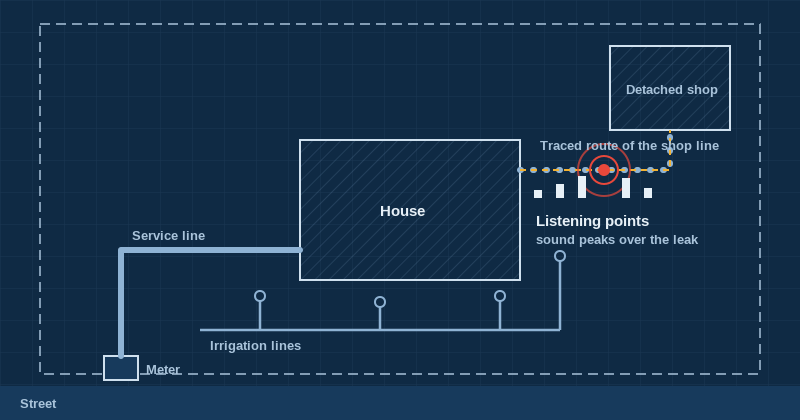
- Acoustic listening and line tracing on buried lines and under slabs.
- Tracer gas on plastic lines and where background noise from traffic or equipment makes listening hard.
- Thermal imaging and moisture mapping inside occupied spaces.
What happens during a commercial inspection
Expect more planning up front. The provider will want to know which meters serve which buildings, where the shutoffs are, what operating hours to work around and who can authorize water shutoffs. Testing that requires shutting water off may be scheduled early, late or on a closed day. Tenants may need notice before access to units.
Ask for written findings. Property managers, owners and insurers often need a record of what was tested, what was found and where.
What happens after the leak is found
The marked location and findings go to whoever will make the repair, whether that’s the provider, a commercial plumber or the property’s maintenance team. On multi-building sites, it’s worth keeping the traced line routes for future work. If your water provider offers leak adjustments on commercial accounts, the repair documentation is usually what they ask for.
Why early detection matters
On a commercial account, a leak can run for a full billing cycle before anyone reviews the bill. Meanwhile water may be damaging tenant spaces, undermining paving or soaking a slab under a business that can’t easily close for repairs. Regular meter reviews catch problems while they’re small.
What commercial leak detection may cost
Cost depends on the size of the property, the number of meters, buildings and lines, the need for after-hours work, tenant coordination, and which methods are required. Each provider prices independently, and larger investigations are often quoted after an initial conversation.
When to call
Call when usage rises without a reason, the meter moves when the property is closed, or tenants report signs of a leak. Call right away for active water in occupied spaces, water near electrical equipment, or pavement washing out.
Frequently asked questions
Can leak detection be done without closing the business?
Often, yes. Many tests can run during low-use hours, and shutoffs can be scheduled before opening, after closing or on closed days.
We have several meters. Does that help?
Yes. Comparing meters and submeters can narrow a leak to one building, zone or system before any equipment comes out.
Can you provide documentation for insurance or ownership?
Ask your provider when you’re connected. Many supply written findings showing what was tested and where the leak was located.
Do providers handle apartment complexes?
Many do. Multifamily work often involves unit-by-unit isolation and tenant notices, so allow time for coordination.
What about irrigation on commercial sites?
Pressurized irrigation mains are a common source of commercial leaks and are part of a leak investigation. Leaks in heads and downstream zone lines are usually handled by irrigation contractors.
How often should commercial water use be reviewed?
Monthly review of each meter catches most leaks early. A sudden change from the same month last year is worth investigating.
Where commercial leak detection comes up most in Texas
These city pages explain why commercial leak detection matters locally, from soil and housing age to how water is supplied. Open a region to see its cities, or browse every service area.
Dallas–Fort Worth Metroplex (12)
- Dallas, TXApartment complexes, offices and retail centers make up a large share of the city’s water accounts.
- Irving, TXLas Colinas and the Highway 114 and 161 corridors are full of offices, hotels and large apartment communities.
- Richardson, TXThe Telecom Corridor along Central Expressway and around UT Dallas is dense with offices and campuses.
- Carrollton, TXWarehouses and light industrial sites along the I-35E and Trinity Mills corridors have their own meters and buried lines.
- Lancaster, TXLarge distribution centers along the I-20 and I-45 corridors have their own meters and long buried lines.
- Plano, TXCorporate campuses, retail centers and apartment communities along the tollway and US 75 have large, complex systems.
- Lewisville, TXApartment communities, retail along I-35E and light industry make up much of the water use.
- Arlington, TXApartment communities, the entertainment district and retail corridors have big, complex water systems.
- Grapevine, TXHotels, the airport area, Main Street businesses and large apartment communities make up much of the city’s water use.
- Haltom City, TXIndustrial and commercial sites along the main corridors have their own meters and buried lines.
- Euless, TXApartment communities, hotels and businesses near the airport have large systems and shared meters.
- Ennis, TXManufacturing and distribution sites in the industrial parks along I-45 run long buried lines and large restroom and process systems.
Greater Houston and the Upper Gulf Coast (4)
- Pasadena, TXRefineries, plants and shops along the Ship Channel have long buried lines and large systems.
- Texas City, TXRefineries, port facilities and industrial sites have large systems and long buried lines.
- Baytown, TXRefineries, chemical plants and port-related businesses have large, complex water systems.
- Deer Park, TXRefineries and plants along the Ship Channel have large, complex systems.
Southeast Texas (1)
- Port Arthur, TXRefineries, port facilities and industrial contractors operate large, complex water systems.
North Texas and Texoma (1)
- Sherman, TXLarge industrial projects and growing commercial corridors bring complex water systems.
Rio Grande Valley and the Border (2)
- McAllen, TXShopping centers, medical complexes and offices draw heavily on water and have large systems.
- Pharr, TXCold-storage warehouses and distribution sites tied to the international bridge have large water systems.
West Texas and the Panhandle (1)
- Midland, TXOilfield service yards, offices and new commercial growth have large water systems.