The short answer
Slab leak detection locates a leak in the water lines that run in the soil beneath a concrete foundation. A provider confirms water loss at the meter, pressure-tests the hot and cold lines separately to find which one is leaking, then pinpoints the spot from the floor surface using acoustic listening, thermal imaging, line tracing or tracer gas, and marks it for repair.
What slab leak detection detects
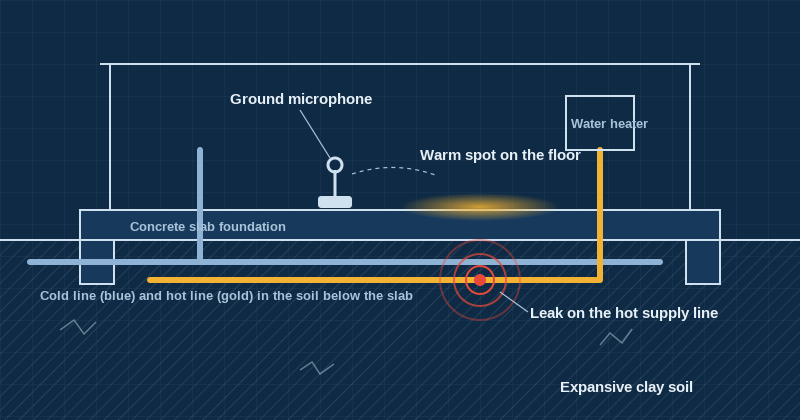
Most Texas homes built on a slab have water lines that run through the soil under the concrete, rising through the floor to kitchens, bathrooms and the water heater. When one of those lines develops a leak, the water escapes into the soil under the house. Nothing may show on the surface for weeks.
Slab leak detection answers three questions in order: is water being lost under the slab, which line is it, and where along that line is the leak. Hot water lines are the most common culprit because heat makes them expand and contract, which wears the pipe where it touches concrete, gravel or other pipe.
Drain lines under the slab can leak too, but those are tested separately because they only leak when water goes down the drain.
Signs of a slab leak
- A warm or hot spot on a hard floor, usually tile, that stays warm at night and doesn’t move with the sun.
- The sound of running water under the floor with everything off.
- A water heater that runs more often, or hot water that runs out sooner.
- A rising water bill with no change in household use.
- Damp carpet, cupped wood or loose tile in an area with no fixture above it.
- Water at the edge of the slab or along an exterior wall.
- Mildew or a musty smell that comes from the floor rather than the walls.
- Lower water pressure throughout the house.
Cracks in tile or drywall are often blamed on slab leaks, but on their own they’re more often caused by normal foundation movement. Look for them alongside other signs.
Common causes of slab leaks
- Abrasion. Lines that rub against concrete, gravel or each other wear thin, especially hot lines that move with temperature.
- Corrosion. Copper can pit from the inside depending on water chemistry and age.
- Soil movement. Expansive clay common across much of Texas swells and shrinks with moisture, shifting the soil around pipes and straining fittings where lines rise through the slab.
- Installation damage. A line kinked, nicked or poorly bedded during construction may fail years later.
- Pipe material. Some older materials, including polybutylene used in homes built roughly from the late 1970s to the mid-1990s, have a known history of failure.
- High water pressure. Excess pressure adds stress to every joint and pipe wall.
How slab leaks are detected
- Meter check. With everything off, the meter shows whether water is being lost and roughly how fast.
- Pressure isolation. The hot and cold sides are shut off and gauged separately. A line that loses pressure is the leaking one.
- Line tracing. If the route isn’t known, an electronic locator maps where the leaking line runs under the slab.
- Acoustic listening. A ground microphone placed on the floor along the line picks up the sound of water escaping under pressure. The sound is usually loudest directly over the leak.
- Thermal imaging. On a hot line, a thermal camera can show the warm plume spreading through the slab from the leak.
- Tracer gas. For quiet leaks or plastic pipe, the line is drained and filled with a harmless gas mix. A sensor on the floor picks up where it rises.
The mark on the floor is the provider’s best estimate of the leak location. Ask how close they expect it to be before anyone breaks concrete.
What happens during an inspection
Expect the provider to start at the meter, then the water heater and the main shutoff. They’ll ask you to keep water off while lines are tested. You may hear them walking the floor with a listening device and see them mark tile or carpet with tape.
Clear access to the water heater, every bathroom and kitchen, and any room where you’ve noticed warmth or dampness. If you have rugs or furniture over a suspect area, it helps to move them. Visits for a single leak in an average home often take one to a few hours.
What happens after the leak is found
Common repair options include:
- Spot repair. Opening the floor at the marked location, repairing the pipe and restoring the slab and flooring.
- Reroute. Abandoning the leaking section and running a new line through walls or the attic instead of under the slab.
- Repipe. Replacing more of the system when lines have failed repeatedly or the pipe material is a known problem.
Each has trade-offs in cost, disruption and how long the fix is likely to last. Ask the provider or plumber to explain why they recommend one over another.
Why early detection matters
A slab leak saturates the soil under the house. On expansive clay, that can make the soil swell in one area and contribute to uneven foundation movement. Water can also wick into flooring and baseboards and feed mold under carpet pad. A hot line leak keeps your water heater running, which costs energy on top of water.
The earlier a slab leak is found, the more likely a small spot repair will solve it.
What slab leak detection may cost
Local leak detection specialists set their own prices. Factors that affect cost include the size of the home, the number of lines that need testing, the flooring type over the suspected area, whether line tracing or tracer gas is needed, and after-hours scheduling. Repair is usually priced separately and depends heavily on flooring and the repair approach.
When to call
Call soon if you have a warm spot plus a high bill, hear water under the floor, or see water coming up at the slab edge. If water is surfacing inside the house, shut off the main and call right away.
Frequently asked questions
Can a slab leak be found without breaking the floor?
Yes. Detection is done from the surface using pressure tests, listening equipment, thermal imaging and tracer gas. Concrete only comes up for the repair, and only at the marked location.
Is a warm spot on the floor always a slab leak?
No. Sunlight, a nearby duct or a radiant heat source can warm a floor. A slab leak warm spot usually stays warm at night, stays in one place and shows up alongside other signs.
Does a slab leak mean my foundation is damaged?
Not necessarily. A slab leak is a plumbing problem. Over time, water under a slab on expansive clay can contribute to foundation movement, which is one reason to find it early.
Should I repair or reroute?
It depends on where the leak is, how old the pipe is and whether there have been other leaks. A single leak on otherwise sound pipe is often spot repaired. Repeated leaks often point toward rerouting.
How long does slab leak detection take?
Often one to a few hours for a single leak. Multiple leaks, unknown pipe routes or quiet leaks can take longer.
Will my insurance cover a slab leak?
Many policies cover resulting water damage and some cover access to the leak, but not the pipe itself. Coverage varies, so check your policy.
Can a slab leak be on a drain line?
Yes, but drain leaks only show when water is used, so they’re tested differently. Supply line leaks run constantly and move the meter.
Could foundation repair cause a slab leak?
Lifting or leveling a slab can stress the lines underneath. Some homeowners have the plumbing pressure-tested after foundation work to make sure nothing was damaged.
Local slab leak detection guides
- Slab Leak Detection in Bryan, TXWarm tile, clay subsoil and how slab leaks are pinpointed in Bryan homes.
- Slab Leak Detection in Temple, TXHouston Black clay, foundation movement and how slab leaks are located in Temple.
- Slab Leak Detection in Longview, TXLeaks that drain away unseen, and how slab leaks are pinpointed in East Texas soil.
- Slab Leak Detection in Victoria, TXCoastal clay, post-storm checks and how slab leaks are located from the floor.
Where slab leak detection comes up most in Texas
These city pages explain why slab leak detection matters locally, from soil and housing age to how water is supplied. Open a region to see its cities, or browse every service area.
Dallas–Fort Worth Metroplex (52)
- Dallas, TXMost Dallas homes built after World War II sit on slabs over clay that swells and shrinks, which is hard on under-slab lines.
- Irving, TXIrving’s single-family neighborhoods are mostly slab homes from the 1960s through the 1990s.
- Garland, TXMost Garland homes are slab-on-grade over expansive clay, and many are decades old.
- Mesquite, TXMesquite is overwhelmingly single-family slab housing on expansive clay.
- Richardson, TXRichardson’s core is midcentury slab homes on clay, many with original or partially replaced supply lines.
- Carrollton, TXMost Carrollton homes are slab-on-grade, and much of the housing dates from the city’s growth in the 1970s, 80s and 90s.
- Grand Prairie, TXGrand Prairie’s homes, from the older north side to newer subdivisions near Joe Pool Lake, are mostly slabs on clay.
- Duncanville, TXDuncanville’s neighborhoods are mostly slab homes from the 1960s and 1970s, an age when under-slab lines start failing.
- DeSoto, TXDeSoto’s neighborhoods are slab-on-grade, from established 1970s–80s streets to homes built after 2000.
- Cedar Hill, TXCedar Hill homes are mostly slabs, and the escarpment’s mix of clay and limestone puts uneven stress on foundations.
- Lancaster, TXMost Lancaster homes are slabs on expansive clay, from older neighborhoods to newer subdivisions.
- Balch Springs, TXMost homes in Balch Springs are on slabs over clay, and many are several decades old.
- Rowlett, TXRowlett is almost entirely single-family slab homes on clay, most from the 1980s through the 2000s.
- Sachse, TXSachse is almost all single-family slab homes on clay.
- University Park, TXNewer rebuilds and many midcentury homes sit on slabs over the area’s clay.
- Coppell, TXCoppell’s homes are overwhelmingly slabs, and most date from the 1980s and 1990s.
- Plano, TXMost Plano homes are slabs built in the 1980s and 1990s, now old enough for under-slab lines to fail.
- Frisco, TXFrisco homes are slabs on expansive clay, and even newer slabs move enough to stress fittings.
- McKinney, TXMost McKinney homes are slabs built since 2000 on expansive Blackland clay.
- Allen, TXAllen is mostly single-family slab homes on clay, built largely in the 1990s and 2000s.
- Prosper, TXHomes are slabs on expansive clay, and even new slabs move enough to stress fittings.
- Murphy, TXMurphy homes are slabs on expansive clay that moves seasonally.
- Wylie, TXWylie is mostly single-family slab homes on expansive clay, many built since 2000.
- Little Elm, TXLittle Elm homes are slabs on clay, and lakeside soils can stay wet and move.
- The Colony, TXThe Colony’s older neighborhoods are 1970s and 1980s slab homes with plumbing now 40 to 50 years old.
- Lewisville, TXSingle-family neighborhoods are mostly slab homes from the 1970s through the 1990s.
- Flower Mound, TXMost homes are slabs built in the 1980s and 1990s, now at the age where under-slab leaks become common.
- Corinth, TXCorinth is mostly single-family slab homes, built largely from the 1990s on.
- Denton, TXMost Denton homes are slabs, from midcentury neighborhoods to newer subdivisions.
- Rockwall, TXRockwall’s homes are mostly slabs on expansive clay, many built since 2000.
- Forney, TXForney is overwhelmingly newer slab homes on expansive Blackland clay.
- Greenville, TXMany Greenville homes are older slabs on expansive Blackland clay.
- Fort Worth, TXMost Fort Worth homes are slabs, and the city’s clay and shallow limestone put uneven stress on foundations and under-slab lines.
- Arlington, TXMost Arlington homes are slabs built from the 1970s through the 1990s on expansive clay.
- North Richland Hills, TXMost homes are slabs, and many in the southern half of the city date from the 1960s through the 1980s.
- Grapevine, TXMost Grapevine homes are slabs from the 1980s and 1990s, an age when under-slab leaks become common.
- Bedford, TXBedford’s homes are mostly slabs from the 1970s and 1980s, with plumbing now 40-plus years old.
- Haltom City, TXMost Haltom City homes are older slabs, many built before 1980.
- Saginaw, TXSaginaw homes are slabs, mostly built in the 1990s and 2000s.
- Mansfield, TXMansfield is mostly newer slab homes on expansive clay.
- Hurst, TXMost Hurst homes are slabs from the 1950s through the 1970s, with original lines well past middle age.
- Watauga, TXWatauga is nearly all single-family slab homes, most from the 1970s and 1980s.
- Euless, TXSingle-family neighborhoods are mostly slabs from the 1970s and 1980s.
- Burleson, TXBurleson’s homes are mostly slabs, about half built since 2000, on expansive clay.
- Keller, TXKeller’s homes are slabs, mostly built from the 1990s onward.
- Southlake, TXHomes are large slabs, where finding a leak precisely saves a lot of flooring.
- Colleyville, TXMost homes are slabs from the 1980s and 1990s, at the age where under-slab leaks increase.
- Weatherford, TXMost homes are slabs, from older neighborhoods to new subdivisions.
- Cleburne, TXMany Cleburne homes are older slabs on expansive clay.
- Midlothian, TXMost Midlothian homes are newer slabs on clay over limestone.
- Waxahachie, TXNewer subdivisions and many midcentury homes are slabs on expansive Blackland clay.
- Ennis, TXEnnis neighborhoods sit on deep, dark Blackland clay that swells hard after spring rain and cracks open in August, working on every slab in town.
Greater Houston and the Upper Gulf Coast (20)
- Houston, TXMost Houston homes are slabs on Gulf Coast clay that shrinks in drought and swells after storms, a steady strain on under-slab lines.
- Pasadena, TXMost Pasadena homes are older slabs on Gulf Coast clay, many built in the 1950s and 1960s.
- Pearland, TXPearland is mostly slab homes on expansive Gulf Coast clay, a majority built after 2000.
- Channelview, TXMost homes are slabs on Gulf Coast clay, from older neighborhoods to newer subdivisions.
- Rosenberg, TXMost Rosenberg homes are slabs on Brazos River bottom clay, which shrinks and swells with the weather.
- Fresno, TXFresno is mostly newer slab homes on Gulf Coast clay.
- Dickinson, TXMost Dickinson homes are slabs on coastal clay, many decades old.
- Texas City, TXMost Texas City homes are older slabs on coastal clay.
- League City, TXLeague City is mostly newer slab homes on coastal clay.
- Conroe, TXMost Conroe homes are slabs, from older neighborhoods near downtown to new subdivisions.
- Baytown, TXMost Baytown homes are older slabs on coastal clay.
- Missouri City, TXMissouri City is overwhelmingly single-family slab homes on Gulf Coast clay.
- La Porte, TXMost La Porte homes are slabs on coastal clay, many decades old.
- Deer Park, TXMost Deer Park homes are slabs from the 1950s through the 1970s, with plumbing now 50-plus years old.
- Sugar Land, TXSugar Land is mostly slab homes on expansive clay near the Brazos River.
- Spring, TXSpring is mostly single-family slab homes on clay and sandy loam.
- Friendswood, TXFriendswood is mostly owner-occupied slab homes on coastal clay.
- Alvin, TXMany Alvin homes are older slabs on coastal clay.
- Katy, TXKaty-area homes are slabs on flat, clay-rich former rice prairie.
- Angleton, TXMany Angleton homes are older slabs on low coastal clay.
Southeast Texas (2)
- Beaumont, TXMost Beaumont homes are slabs on heavy clay, many built before 1980.
- Port Arthur, TXMost Port Arthur homes are older slabs on low coastal clay.
South Texas Gulf Coast (3)
- Corpus Christi, TXMost Corpus Christi homes are slabs on coastal clay that shrinks in drought and swells after storms.
- Portland, TXPortland homes are mostly slabs on coastal clay.
- Kingsville, TXMany Kingsville homes are older slabs on clay and caliche soils.
Central Texas and the Brazos Valley (8)
- Waco, TXMany Waco homes are older slabs on expansive Blackland clay.
- Killeen, TXMost Killeen homes are slabs, many built since 2000, on clay and shallow limestone.
- Harker Heights, TXHarker Heights homes are mostly slabs, many built since 2000, on hilly limestone and clay.
- Copperas Cove, TXMost Copperas Cove homes are slabs on rocky limestone and clay.
- Fort Hood, TXMost off-post homes around the post are slabs on clay and limestone.
- Belton, TXMost Belton homes are slabs, on clay in some areas and shallow limestone in others.
- College Station, TXSingle-family homes and duplexes are mostly slabs on Brazos County clay.
- Corsicana, TXMany Corsicana homes are older slabs on expansive Blackland clay.
Austin and the I-35 Corridor (9)
- Austin, TXEast of MoPac, most Austin homes sit on expansive Blackland clay that moves slabs and under-slab plumbing every season.
- Round Rock, TXRound Rock homes are slabs, on clay east of I-35 and rockier ground to the west.
- Cedar Park, TXCedar Park homes are slabs, mostly built since the 1990s, on rocky limestone ground.
- Leander, TXLeander homes are slabs on rocky ground, where fittings rather than old pipe cause most leaks.
- Pflugerville, TXPflugerville is mostly single-family slab homes on very expansive Blackland clay.
- Georgetown, TXMost Georgetown homes are slabs, on limestone to the west and clay to the east.
- Hutto, TXHutto homes are nearly all newer slabs on deep, expansive Blackland clay.
- Kyle, TXKyle homes are almost all newer slabs, most on expansive clay east of I-35.
- San Marcos, TXSingle-family homes are mostly slabs, on clay to the east and rockier ground to the west.
San Antonio and the Hill Country (8)
- San Antonio, TXMuch of San Antonio is slab homes on expansive clay that shrinks in drought and swells after rain.
- New Braunfels, TXNew Braunfels homes are mostly slabs, on clay east of I-35 and rock to the west.
- Seguin, TXMany Seguin homes are older slabs on clay soils.
- Schertz, TXSchertz homes are mostly slabs on expansive clay, close to half built since 2000.
- Cibolo, TXFoundations sit on clay that heaves after heavy rain along the Cibolo Creek watershed.
- Converse, TXThe older core near FM 78 has slab homes with original plumbing now several decades old.
- Universal City, TXMany Universal City homes are older slabs on clay.
- Kerrville, TXMost homes are slabs on limestone, where pinpointing before breaking concrete matters.
East Texas (2)
- Tyler, TXMost homes built since the 1960s are slabs on red sandy clay.
- Marshall, TXHomes from the 1960s onward are mostly slabs with original lines aging out.
North Texas and Texoma (4)
- Sherman, TXMany Sherman homes are older slabs on expansive clay, with newer subdivisions on the same soil.
- Denison, TXMany Denison homes are older slabs on clay soils.
- Wichita Falls, TXMost Wichita Falls homes are older slabs on clay that cracks in drought.
- Paris, TXMany Paris homes are older slabs on clay.
Rio Grande Valley and the Border (11)
- Laredo, TXMost Laredo homes are slabs on clay and caliche that crack in drought.
- Brownsville, TXMost Brownsville homes are slabs on flat Rio Grande delta clay.
- Harlingen, TXMost Harlingen homes are slabs on flat delta clay, many decades old.
- McAllen, TXMost McAllen homes are slabs on flat Rio Grande delta clay.
- Edinburg, TXEdinburg homes are mostly slabs on delta clay, close to half built since 2000.
- Mission, TXMost permanent homes are slabs on delta clay, many built since 2000.
- Pharr, TXMost Pharr homes are slabs on delta clay, close to half built since 2000.
- Weslaco, TXMost Weslaco homes are slabs on delta clay, split between older and newer construction.
- San Juan, TXMost San Juan homes are single-family slabs on delta clay.
- Alamo, TXPermanent homes are mostly slabs on delta clay.
- San Benito, TXMany San Benito homes are older slabs on delta clay.
West Texas and the Panhandle (8)
- El Paso, TXMost El Paso homes are slabs on desert soils and caliche, where leak water often stays hidden.
- Lubbock, TXMost Lubbock homes are slabs on clay loam over caliche, about half built before 1980.
- Amarillo, TXMost homes are slabs on clay loam and caliche, many built before 1980.
- Midland, TXMidland homes are mostly slabs on caliche-laden soils.
- Odessa, TXMany Odessa homes are older slabs on caliche-laden soil.
- San Angelo, TXMost San Angelo homes are slabs, about two thirds built before 1980.
- Big Spring, TXBig Spring’s homes are overwhelmingly older slabs, with original plumbing decades old.
- Plainview, TXMost Plainview homes are older slabs, about eight in ten built before 1980.