The short answer
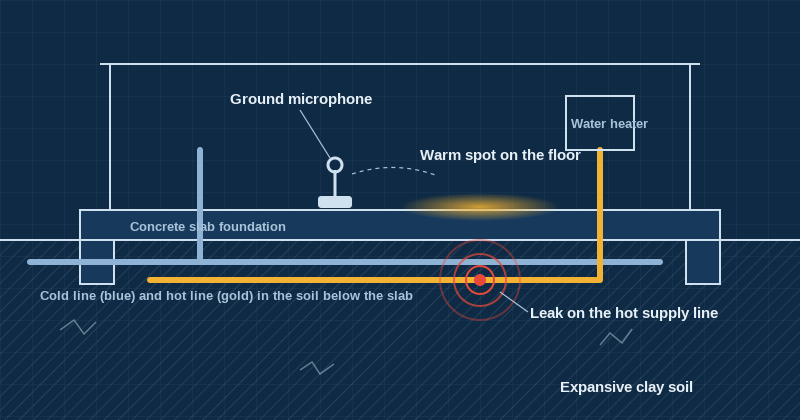
A slab leak in Longview is a leak in a water line beneath a concrete foundation. Because East Texas soils are often sandy or loamy on top with clay below, leak water can drain away without surfacing. Detection relies on the meter, hot and cold pressure isolation, and pinpointing from the floor with listening equipment, thermal imaging or tracer gas.
Signs of a slab leak in Longview
- The meter moves with every fixture off, but the house shutoff stops it.
- A warm area on tile or concrete that stays warm overnight.
- A water heater that runs more often than it used to.
- Damp carpet pad or baseboards with no fixture nearby.
- The sound of running water under the floor.
- A higher bill with no change in household use.
What you often won’t see in Longview is water coming up at the slab edge. That’s a soil difference, not a sign there’s no leak.
What’s different about slab leaks in Longview
Leak water tends to drain down. Federal soil surveys for this part of East Texas describe sandy or loamy surface soils with clay increasing with depth. Water escaping from a line under a slab can move down and away through the sandier layer instead of pooling or pushing up. Where the clay layer is shallower, water may collect along it and travel sideways. Either way, it can be a long time before anything shows at the surface.
Less dramatic soil swelling, same pipe wear. These soils don’t usually swell as hard as the heavy clays of Central Texas, so soil movement is often a smaller factor here. Slab leaks in Longview are more often about pipe age, material, abrasion of hot lines and installation damage.
A city of mixed foundations. Longview has slab homes alongside older pier-and-beam houses. If you’re not sure which you have, look for foundation vents, a crawlspace hatch or skirting. No crawlspace means the lines are under concrete and need to be located from the floor. If you have a crawlspace, see crawlspace leak detection in Longview instead.
Some homes are part slab, part crawlspace. Additions built on a slab next to an original pier-and-beam house aren’t unusual in older neighborhoods. Lines may run under both, so the provider will want to know the history of the house.
Common causes
- Hot line abrasion against concrete, fill or other pipes.
- Pinhole corrosion in copper lines.
- Failed fittings where lines rise through the slab.
- Damage during construction or later remodeling.
- Older pipe materials such as polybutylene in homes from the era it was used.
- High water pressure stressing the whole system.
How slab leaks are pinpointed
- Meter test with everything off, then with the house shutoff closed, to confirm the leak is inside the house.
- Hot and cold isolation with gauges to find the leaking side.
- Line tracing under the slab where the route isn’t known.
- Acoustic listening from the floor along the line. Sandy fill can carry sound differently from clay, so readings are compared along the full route.
- Thermal imaging for hot-side leaks.
- Tracer gas for quiet leaks and plastic pipe, rising through the slab joints and flooring at the leak.
What the inspection involves
The provider will check the meter, the water heater and the house shutoff, then test the lines. Clear floor space over any warm or damp areas, and tell them about additions, remodels and earlier plumbing repairs. If part of the house is on piers, they’ll need access to the crawlspace too.
What happens after detection
Options include a spot repair through the floor at the marked spot, a reroute that runs a new line through the walls or attic, or a repipe if the lines have failed repeatedly. In a house that’s partly on piers, a reroute through the crawlspace can sometimes avoid the slab entirely. Ask which option fits your layout.
When to call
Call when the meter shows a leak that stops at the house shutoff, especially with a warm floor or a busy water heater. If water appears through the floor, shut off the main and call right away.
Frequently asked questions
Why isn’t water coming up anywhere if I have a slab leak?
In sandy-topped East Texas soil, water often drains away under the slab instead of surfacing. The meter and a warm floor are better clues.
Is my Longview home more likely to have a slab leak or a crawlspace leak?
It depends on the foundation. Slab homes have lines under concrete; pier-and-beam homes have them under the floor. Some older homes have both.
Does soil movement cause slab leaks in Longview?
It can contribute, but pipe age, material and wear are usually bigger factors here than in the heavy clay areas of Central Texas.
Can a slab leak be found if the pipe is plastic?
Yes. Plastic pipe is quieter, so tracer gas is often used.
Will the provider need to break concrete?
Only for the repair, and only at the marked spot. A reroute can avoid the slab altogether.
More leak detection in Longview
- Water leak detection in LongviewThe Longview overview: local leak patterns, coverage and ZIP codes.
- Crawlspace Leak Detection in LongviewUnder-floor plumbing, freeze damage and what to check after a cold snap.
- How slab leak detection worksThe full statewide guide: methods, costs and what to expect anywhere in Texas.
- Water Meter Leak DetectionUsing the meter to confirm a leak and narrow down where the water is going, including high-bill investigations.
- Water Service Line Leak DetectionFinding leaks on the buried pipe between the water meter and the house.
Sources for the local details on this page
- Longview, TX ZIP code list and ZIP types
- ZIP 75605 details including the Greggton alias (zip-codes.com)
- ZIP codes in the Longview, TX metro area
- USDA NRCS ecological site, Western Coastal Plain (East Texas soils)
- Ground-water resources of Gregg County, USGS Water-Supply Paper 1079-B
- Winter Storm Uri insurance losses and burst pipes (Texas Department of Insurance)
ZIP codes, nearby communities and soil notes come from the public sources above. Utility policies change, so confirm anything about billing or responsibility with your own water provider.