The short answer
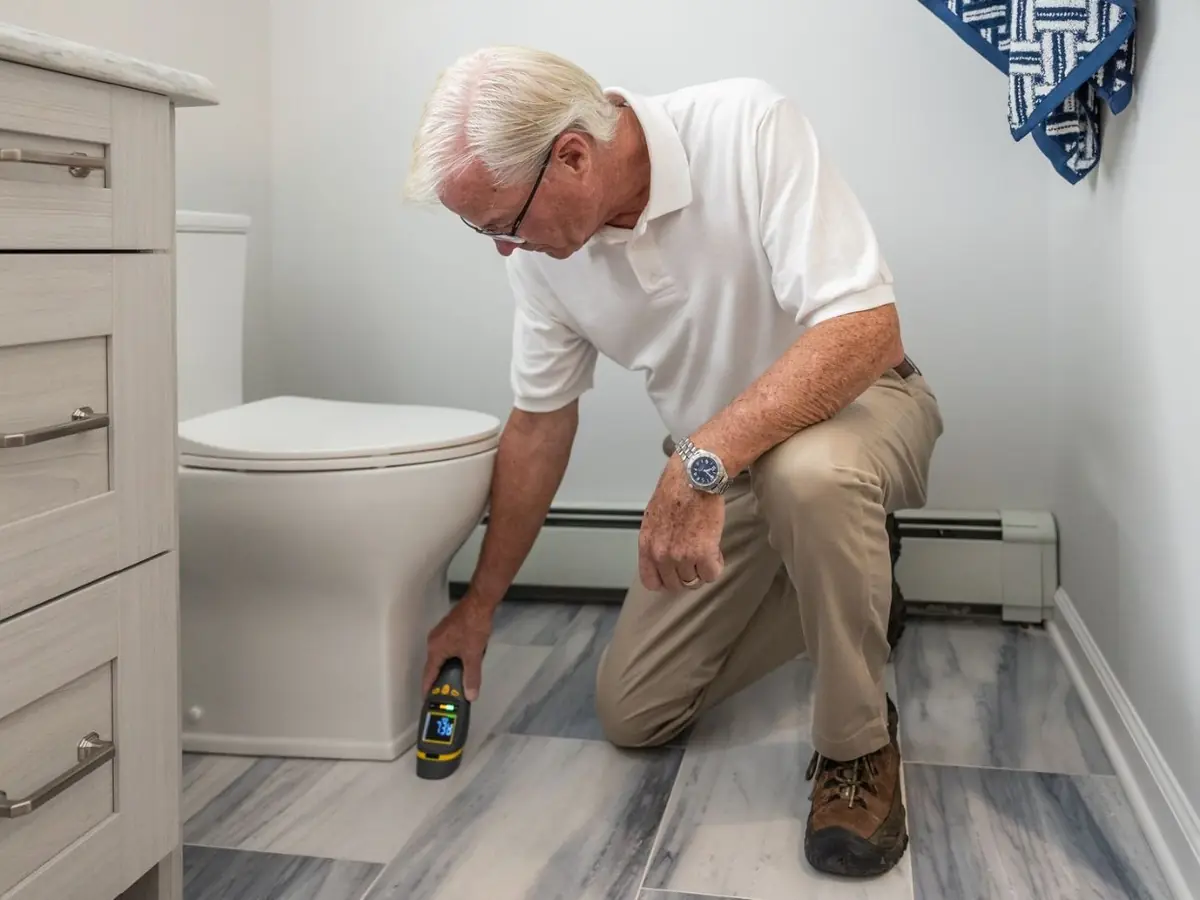
Water leak detection finds the exact location of a leak in a pressurized water system without opening walls, floors or ground at random. A provider confirms water loss at the meter, isolates sections of plumbing to narrow the search, then pinpoints the leak with listening equipment, line tracing, thermal imaging, moisture readings or tracer gas.
What leak detection covers
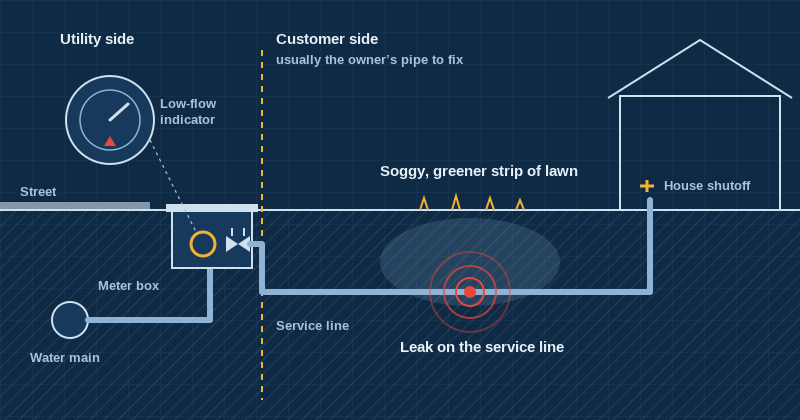
Leak detection deals with the pressurized side of plumbing: the lines that carry water from the meter into and through a building. Because they’re always under pressure, these lines leak around the clock, not just when a fixture is in use. That’s why a small supply leak can move a meter and a bill so noticeably.
The search usually falls into one of these areas:
- The service line between the meter and the house.
- Under-slab lines on homes built on a concrete foundation.
- Lines in walls and ceilings, including second-floor bathrooms and attic water heaters.
- Under-floor lines in pier-and-beam homes with a crawlspace.
- Buried lines elsewhere on the property, such as irrigation mains or lines to a shop or barn.
- Fixtures and appliances that leak inside the system, such as toilets, softeners and ice makers.
Drain and sewer leaks are a different problem. They only leak when water is sent down the drain, so they don’t move the meter when everything is off. A provider can usually tell you which kind you’re dealing with after a few simple tests.
Signs you may need leak detection
- The meter’s low-flow indicator moves with every fixture off.
- Your water bill rose and stayed up without a change in use.
- You can hear water running in a wall, under the floor or near the meter.
- A floor area is warm, damp or discolored.
- Drywall is soft, paint is bubbling or a ceiling stain is spreading.
- A patch of the yard stays wet or grows faster than the rest.
- Water pressure dropped at several fixtures.
- A musty smell keeps returning in one area.
If more than one of these applies, it’s worth a meter test today. See water meter leak detection for how.
Common causes of hidden leaks
Most hidden leaks come from a handful of causes, often working together.
- Corrosion. Copper can develop pinholes over time, and older galvanized steel rusts from the inside out. Water chemistry and age both play a part.
- Abrasion. Hot water lines expand and contract. Where a pipe rubs against concrete, gravel, framing or another pipe, the wall can wear thin.
- Soil movement. Much of Texas sits on clay that swells when wet and shrinks when dry. That movement stresses buried lines and pipes under slabs.
- Freezing. Lines in exterior walls, attics and crawlspaces can split in a hard freeze. The leak often appears only after the thaw.
- Installation damage. Kinked, nicked or poorly supported pipe can fail years after the house was built.
- Failed fittings and connections. Joints, valves, supply hoses and fixture connections are common weak points.
- High water pressure. Pressure that’s too high puts extra strain on every pipe and fitting in the house.
Detection methods
Not every provider uses every method, and not every leak needs them all. The right mix depends on where the leak is likely to be and what the pipe is made of.
| Method | What it does | Best suited to |
|---|---|---|
| Meter monitoring | Confirms water loss and estimates the rate | Every investigation, as the first step |
| Pressure testing | Isolates lines and watches for pressure drop | Narrowing a leak to the service line, hot side, cold side or a branch |
| Acoustic detection | Listens through the floor or ground for escaping water | Slab leaks and buried lines |
| Line tracing | Maps the route of a pipe from the surface | Lines with unknown paths, before pinpointing |
| Thermal imaging | Shows temperature differences on surfaces | Hot water lines, wet areas in walls and ceilings |
| Moisture mapping | Measures moisture in drywall, wood and flooring | Wall, ceiling and floor leaks |
| Tracer gas | Fills a drained line with a safe gas and detects where it escapes | Quiet leaks, plastic pipe, hard-to-hear locations |
What happens during an inspection
- You describe the symptoms, when they started and anything you’ve already tried.
- The provider reads the meter and checks for flow with everything off.
- They locate the main shutoff, water heater and the general route of the lines.
- Sections of the system are isolated and tested to find which one is losing water.
- The leaking section is scanned with the method that suits it, and the likely leak point is marked.
- You get an explanation of what was found and what the repair options are.
Plan to be home for the visit, with access to the meter, water heater, attic or crawlspace and any rooms with damage.
Why early detection matters
A small supply leak runs all day and all night. Even a slow one adds up on the bill, and the water has to go somewhere: into subfloor, framing, insulation or the soil around a foundation. The longer it runs, the more material gets wet, the more likely mold becomes and the bigger the eventual repair.
Finding a leak early doesn’t mean panicking over every damp spot. It means checking the meter when something seems off, and getting help when the meter confirms a problem.
What leak detection may cost
Pricing is set by each independent provider, so there’s no single number for Texas. What tends to move the price:
- The size of the property and how many lines need testing.
- How easy it is to reach the meter, water heater and plumbing.
- Which methods are needed. Tracer gas and line tracing add time.
- Whether there’s more than one leak.
- After-hours or same-day scheduling.
- Travel distance for rural properties.
- Whether the visit includes repair or only location.
Ask for the price of the detection visit and what it includes before the provider arrives.
When to call
Call right away if water is visibly escaping, a ceiling is sagging, or water is near electrical outlets or panels. Shut off the water at the main first. The emergency leak guide covers what to do in those first minutes.
Book a regular visit if the meter test shows a leak, your bill has risen for two cycles in a row, or you have a warm spot, damp wall or wet patch that isn’t getting better.
Want a professional to look at it? Call to request leak detection help in Texas and talk through what you're seeing.
Call 1-866-297-0573Frequently asked questions
What’s the difference between leak detection and plumbing repair?
Leak detection finds where the water is escaping. Repair fixes it. Some providers do both; others locate the leak and leave the repair to a plumber. Locating first keeps the repair small and avoids opening the wrong area.
Can I find a leak myself?
You can confirm one. The meter test and a toilet dye test catch many leaks. Locating a leak inside a slab, wall or buried line usually takes equipment and experience.
Will a provider need to cut into my walls or floor?
Detection is usually non-invasive. A small inspection hole is sometimes needed. The repair itself typically requires opening the floor, wall or ground at the marked spot.
How accurate is professional leak detection?
On a typical accessible leak, providers can often narrow it to a small area. Accuracy depends on pipe material, depth, background noise and how fast the water is escaping. Ask your provider how confident they are and what happens if the first opening misses.
Can a leak stop on its own?
Rarely. Small leaks usually grow. A meter that stops moving may mean a fixture valve closed or an intermittent leak, so it’s worth retesting over a few days.
Do leaks only happen in old houses?
No. Newer homes can have installation damage, failed fittings or freeze damage. Older homes are more likely to have corroded pipe.
What if the leak is in a drain, not a supply line?
Drain leaks only show when water is sent down the drain, so the meter test won’t catch them. Signs include damage that appears after showers or laundry. A provider can test drains separately.
Does homeowners insurance pay for leak detection?
Policies differ. Many cover sudden water damage and some cover the cost of finding the source, but not the failed pipe itself. Check your policy or call your insurer before the visit.
Is water from a hidden leak a health risk?
The water itself usually isn’t. The concern is mold and damaged materials if it keeps running. Leaks near electrical wiring are a safety risk, so shut off water and avoid wet areas around outlets.
Where water leak detection comes up most in Texas
These city pages explain why water leak detection matters locally, from soil and housing age to how water is supplied. Open a region to see its cities, or browse every service area.
Central Texas and the Brazos Valley (1)
- Fort Hood, TXOff-post homes near the installation are where local leak detection specialists can help.