The short answer
Underground leak detection locates leaks in buried water lines anywhere on a property, not only the main service line. Because routes are often undocumented, a provider usually traces where the lines run first, isolates them to find which one is losing water, then pinpoints the leak from the surface with acoustic listening or tracer gas.
What underground leak detection covers
The service line from the meter to the house is just one buried line. Many Texas properties have others:
- Irrigation mains feeding sprinkler zones, which stay pressurized up to each zone valve.
- Lines to detached buildings such as shops, barns, guest houses and garages.
- Lines to yard hydrants, livestock troughs and outdoor kitchens.
- Pool and spa fill lines.
- Long rural lines where the meter sits hundreds of feet from the house.
- Private lines on commercial and multifamily sites between buildings.
The hard part is often that nobody knows exactly where these lines run. Detection starts by mapping them.
Signs of an underground leak
- A wet patch, puddle or muddy area that doesn’t dry out.
- Grass or weeds that stay greener in one strip during dry weather.
- Soil that’s settling or a small sinkhole forming.
- The meter moves when the house and irrigation are both shut off.
- Lower pressure at a shop, hydrant or outbuilding.
- An irrigation system that loses pressure or has weak heads in one zone.
- A water bill that rose in a dry month when you weren’t watering more.
In sandy soil, buried leaks may never surface. The water drains away and the only sign is the meter.
Common causes of underground leaks
- Shallow burial. Lines added later, especially to outbuildings and irrigation, are often buried shallower than the main service line.
- Ground movement. Expansive clay, heavy rain and drought all shift the soil around pipes.
- Roots. Large roots can shift, crush or rub against buried lines over time.
- Vehicle loads. Trucks, tractors and trailers crossing a line can crack it.
- Freeze damage. Exposed or shallow sections near hydrants and risers can split in a hard freeze.
- Digging accidents. Fence posts, trenching and landscaping often hit private lines because they aren’t marked.
- Fittings and repairs. Old splices and repair couplings are common failure points.
Detection methods
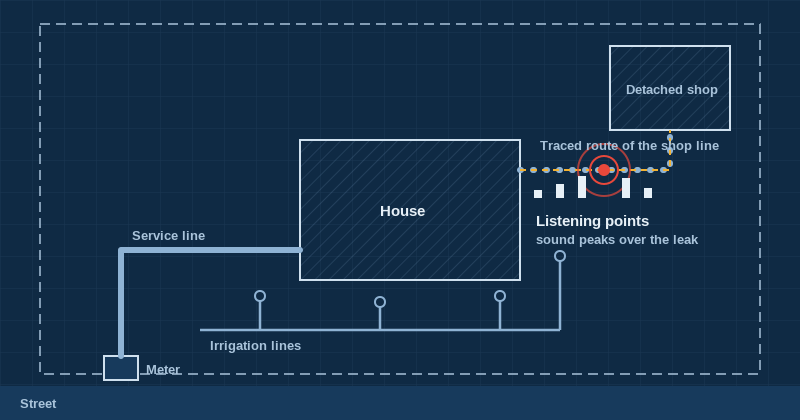
- Isolation. Each line is shut off in turn at its valve while the meter is watched. The one that stops the meter is the one leaking.
- Line tracing. Metal pipe can be traced with an electronic locator. Plastic pipe may need a tracer wire, a signal sent through the line or a transmitter pushed inside it.
- Acoustic listening. A ground microphone is moved along the traced route at intervals. The sound of escaping water typically peaks above the leak.
- Tracer gas. The line is drained and filled with a safe gas mix. Sensors at the surface detect where it comes up. This works well on plastic pipe, which carries sound poorly.
- Visual and moisture checks. Wet soil, settled areas and plant growth help confirm a location.
What happens during an inspection
Tell the provider about every buried line you know of, even ones you aren’t sure still exist. Have keys for gates and outbuildings, and know where valves are if you can. On large properties, the visit may begin with a walk of the site and a look at the meter and any valve boxes before testing starts.
What happens after the leak is found
The leak point is marked on the ground. Repair is usually a small excavation at that spot. Where a line has failed repeatedly, is shallow or runs under a future building or driveway, replacement or rerouting may be recommended. Before digging, public utilities should be marked through Texas811. Private lines aren’t marked by 811, so the traced route from the detection visit is useful to keep.
Why early detection matters
Buried leaks rarely stay small. Escaping water erodes the soil around the pipe, which lets the leak grow and can create voids under driveways and slabs. On a long rural line, a leak can lose a large amount of water before anyone notices.
What underground leak detection may cost
The biggest cost factors are how many lines there are, whether their routes need to be traced, how long they are, the pipe material, and whether tracer gas is needed. Rural travel distance can also affect price. Ask each provider what the visit includes.
When to call
Call when the meter shows a leak and the house itself checks out, or when you see wet ground, sinking soil or unusual growth along a likely line route. Call right away if water is bubbling up or the ground is washing out.
Frequently asked questions
How is a leak found if nobody knows where the pipe runs?
The line is traced first, using an electronic locator on metal pipe or a signal or transmitter on plastic pipe. Once the route is known, the leak is pinpointed along it.
Will 811 mark my private water lines?
No. Texas811 coordinates marking of public utility lines. Lines you own, like irrigation mains and lines to outbuildings, generally aren’t marked.
Can a leak be found in plastic pipe?
Yes, though it can take more work. Plastic carries sound poorly, so tracer gas or close-interval listening is often used.
Is an irrigation leak the same as underground leak detection?
An irrigation main is one kind of buried line. Leaks in sprinkler heads and zone lines downstream of valves are usually handled by irrigation specialists. Leaks in the pressurized main are a leak detection job.
My yard is dry. Can I still have an underground leak?
Yes. In well-drained soil, water can disappear downward. The meter is the more reliable sign.
How long does it take on a large property?
It depends on how many lines there are and whether their routes are known. Tracing can take longer than pinpointing.
Local underground leak detection guides
- Underground Leak Detection in Lufkin, TXSandy soil, long rural lines and roots: tracing and pinpointing buried leaks.
Where underground leak detection comes up most in Texas
These city pages explain why underground leak detection matters locally, from soil and housing age to how water is supplied. Open a region to see its cities, or browse every service area.
Dallas–Fort Worth Metroplex (20)
- Mesquite, TXLarger lots on the city’s east side carry irrigation mains and longer buried runs.
- Grand Prairie, TXLarger lake-area lots often have long service lines, irrigation mains and lines to outbuildings.
- DeSoto, TXBigger lots in the city’s western and southern sections have longer buried runs.
- Cedar Hill, TXHilly, wooded lots near Joe Pool Lake and Cedar Hill State Park often have long or deep buried lines.
- Rowlett, TXLakefront and lake-area lots often carry irrigation, pool lines and longer buried runs.
- Sachse, TXSprinkler mains and yard lines in newer subdivisions can fail at fittings, especially after soil movement.
- Coppell, TXSprinkler mains and buried yard lines on established lots develop leaks with age.
- Frisco, TXSprinkler mains and yard lines in newer subdivisions fail at fittings, often under turf that hides the water.
- Allen, TXEstablished sprinkler systems and yard lines are common leak points on Allen lots.
- Prosper, TXProsper’s larger lots carry long sprinkler mains, pool lines and yard lines that can leak out of sight.
- Murphy, TXSprinkler systems and yard lines are common hidden leak points on Murphy lots.
- Little Elm, TXIrrigation and yard lines on lakeside lots are common hidden leak points.
- Flower Mound, TXLarge, wooded lots have long irrigation mains and yard lines, and tree roots add stress to buried pipe.
- Rockwall, TXLake-area and larger lots carry irrigation, pool lines and longer buried runs.
- Mansfield, TXSprinkler mains, pool lines and longer yard lines are common on larger Mansfield lots.
- Keller, TXLarger lots carry long irrigation mains, pool lines and yard lines, often near mature trees.
- Southlake, TXLarge Southlake lots have long irrigation mains, pool plumbing and yard lines that can leak unseen.
- Colleyville, TXLarge wooded lots have long yard lines and irrigation mains near mature trees.
- Weatherford, TXRural and acreage properties around Weatherford have long buried lines to barns, shops and livestock water.
- Midlothian, TXLarger lots and acreage carry long buried lines and irrigation, sometimes through rocky ground.
Greater Houston and the Upper Gulf Coast (2)
- Conroe, TXLake-area and wooded lots have long buried lines, and some rural properties have wells.
- Alvin, TXRural properties around Alvin have long buried lines to barns, shops and wells.
Austin and the I-35 Corridor (4)
- Round Rock, TXSprinkler mains and yard lines on rocky ground can leak out of sight and are slow to dig.
- Cedar Park, TXRock close to the surface makes buried line leaks slow and expensive to dig, so pinpointing matters.
- Leander, TXIrrigation and yard lines in rocky soil are hard to dig, so accurate location matters.
- Kyle, TXNew irrigation systems and yard lines leak at fittings, often under fresh turf.
San Antonio and the Hill Country (3)
- New Braunfels, TXHill Country lots west of town have long buried lines through rocky ground.
- Converse, TXNewer subdivisions have long irrigation runs and yard lines in backfill that is still settling.
- Canyon Lake, TXHillside lots have long buried lines through rock, often from a meter or well far from the house.
East Texas (1)
- Tyler, TXWooded, hilly lots have long buried lines, and pine roots crowd pipe in sandy soil.
Rio Grande Valley and the Border (1)
- Mission, TXCitrus-area and larger lots have irrigation and long buried lines.