The short answer
Water service line leak detection locates leaks in the underground pipe between the water meter and the building. A provider confirms the leak by closing the house shutoff and watching the meter, traces the line’s route if it isn’t known, then pinpoints the leak by listening at the surface along the line or by using tracer gas on plastic pipe.
What service line detection covers
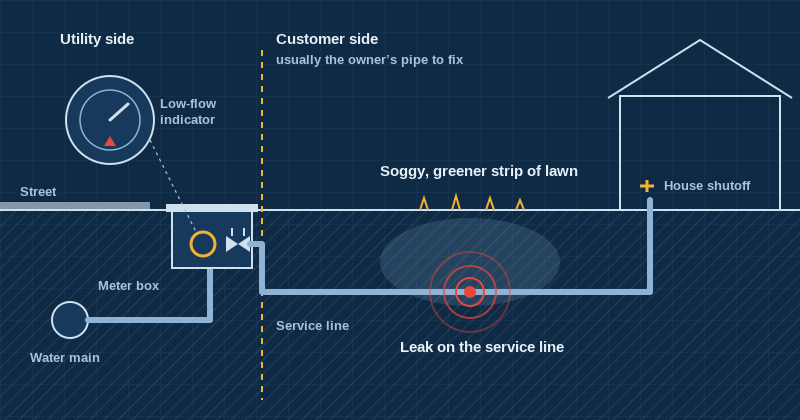
The service line runs underground from the meter, usually near the street, to where water enters the house. Its length depends on the lot: a short run in a subdivision, a long one on a rural property. It’s typically the property owner’s responsibility from the meter to the house, while the water provider handles the pipe and meter on the street side. Confirm the split with your provider, because arrangements vary.
Because the service line carries full pressure all the time, a leak in it runs constantly. It’s also below ground, so the water often disappears into the soil without a trace. Detection focuses on proving the leak is in this section and then finding the spot along its length.
Signs of a service line leak
- The meter keeps moving after you close the main shutoff at the house.
- A strip of lawn between the meter and house stays soggy or grows greener in dry weather.
- Soil, a walkway or the driveway has started to sink along the line’s path.
- Water pools in the meter box when it hasn’t rained.
- Pressure dropped throughout the house at once.
- You hear hissing or running water at the meter box or near where the line enters the house.
- The bill rose with no change in use and no leaks inside.
Common causes of service line leaks
- Age and material. Galvanized steel corrodes from the inside. Some older plastic lines become brittle. Copper can corrode in certain soils.
- Soil movement. Clay that swells and shrinks with Texas wet and dry cycles pulls on fittings and joints.
- Tree roots. Roots don’t usually break into pressurized lines, but large roots can crush, shift or abrade a line as they grow.
- Traffic and loads. Driveways, parked vehicles and heavy equipment can crack lines buried too shallow.
- Freezing. Shallow sections near the meter or where the line rises to the house are vulnerable in hard freezes.
- Digging damage. Fence posts, landscaping and irrigation work can nick a line that later fails.
How service line leaks are detected
- Isolation. The provider closes the house shutoff, confirms it seals, and watches the meter. Movement confirms a leak between the meter and the house, unless irrigation or another branch splits off first.
- Line tracing. If the route isn’t obvious, an electronic locator traces metal pipe directly. Plastic pipe may be traced by a tracer wire if one was installed, or by sending a signal through the line.
- Acoustic pinpointing. A ground microphone is moved along the traced route. Escaping water is usually loudest directly above the leak.
- Tracer gas. On plastic pipe, which carries sound poorly, the line can be drained and filled with a harmless gas that rises through the soil at the leak.
Under federal lead and copper rules, Texas water utilities have had to inventory service line materials, so your provider may already have a record of what your line is made of. It’s worth asking.
What happens during an inspection
The provider will need access to the meter box, the house shutoff and the area between them, including any fenced yards. They’ll ask about the age of the house and whether the line has ever been repaired. Expect them to mark the line route with flags or paint and mark the leak point once it’s found.
What happens after the leak is found
Repair options usually come down to two choices. A spot repair opens the ground at the marked location to fix the pipe. A replacement runs a new line, often by trenching or by boring under driveways and walkways. Repeated leaks on an aging line are a common reason to replace instead of repair.
Before anyone digs, public utility lines should be marked through Texas811. Note that 811 doesn’t mark private lines like your service line, which is one reason line tracing matters.
Why early detection matters
A service line leak runs nonstop. Besides the cost on every bill, the water can soften soil near the foundation, undermine walkways and driveways, and create soft spots in the yard. A small leak also tends to grow as escaping water erodes the soil around it.
What service line detection may cost
Price depends on the length of the line, whether the route needs tracing, the pipe material and the method needed, and whether the line runs under concrete. Repair cost depends on depth, surface material and whether a spot repair or replacement is recommended. Each independent provider sets its own pricing.
When to call
Call when the meter moves with the house shutoff closed. Call right away if water is bubbling up in the yard, the ground is sinking, or pressure in the house has dropped sharply. If water is coming from the street side of the meter, contact your water provider.
Frequently asked questions
Who is responsible for the water line from the meter to my house?
In many Texas communities, the owner is responsible from the meter to the house and the water provider handles the street side. Confirm with your own provider, since policies differ.
Why isn’t there a wet spot in my yard?
Water from a service line leak can drain downward or follow the pipe trench without surfacing, especially in sandy or gravelly soil. A dry yard doesn’t rule out a leak.
Can a service line leak affect my foundation?
It can. Water saturating the soil near a slab, particularly on expansive clay, can contribute to soil movement. Finding the leak early limits that.
How deep is a service line?
It varies by age, local code and lot. Providers trace and mark the route rather than assuming a depth.
Should I repair or replace my service line?
A single leak on a newer line is often repaired. An old, corroded or repeatedly failing line is often replaced. Ask why a provider recommends one or the other.
Can a leak be on the utility side of the meter?
Yes. If water appears on the street side of the meter or the meter box floods without your meter moving, contact your water provider.
Local water service line leak detection guides
- Water Service Line Leak Detection in Temple, TXClay that cracks and swells, flooded meter boxes and how buried lines are traced.
Where water service line leak detection comes up most in Texas
These city pages explain why water service line leak detection matters locally, from soil and housing age to how water is supplied. Open a region to see its cities, or browse every service area.
Dallas–Fort Worth Metroplex (21)
- Garland, TXLong-buried service lines in older neighborhoods are past the age when couplings and fittings start to fail.
- Richardson, TXYard lines in the older neighborhoods have been in the ground for 50 years or more.
- Duncanville, TXYard lines from that era are often the oldest pipe on the property.
- Cedar Hill, TXElevation changes between the meter and the house can make yard-line leaks surface far from where they start.
- Balch Springs, TXOlder yard lines and long runs to homes set back on larger lots are common leak points.
- Wylie, TXYard lines in newer subdivisions can fail at couplings when the clay shifts.
- The Colony, TXOriginal yard lines in those neighborhoods are often the oldest pipe on the property.
- Corinth, TXYard lines on clay soils can fail at couplings as the ground shifts.
- Forney, TXYard lines in new subdivisions can pull at couplings as the clay settles and shifts.
- Greenville, TXOlder yard lines on moving clay are a common source of hidden water loss.
- Fort Worth, TXOlder yard lines in established neighborhoods and long runs in newer exurban areas both see buried leaks.
- North Richland Hills, TXOlder yard lines in established neighborhoods are past the age when couplings and fittings start to fail.
- Bedford, TXOriginal yard lines are as old as the homes they serve.
- Haltom City, TXOld yard lines are a frequent source of hidden leaks in established neighborhoods.
- Saginaw, TXYard lines in newer subdivisions can fail at couplings as backfill settles.
- Hurst, TXYard lines are often as old as the homes and prone to corrosion and coupling failures.
- Watauga, TXOriginal yard lines from that era are aging along with the homes.
- Burleson, TXYard lines in both older and newer subdivisions fail at couplings as the clay moves.
- Weatherford, TXOlder yard lines in town and long service lines on larger lots are frequent sources of hidden leaks.
- Cleburne, TXAging yard lines on moving clay are a common source of hidden water loss.
- Ennis, TXDecades-old yard lines between the street and the house take the brunt of that soil movement at their couplings.
Greater Houston and the Upper Gulf Coast (15)
- Pasadena, TXYard lines that have been in the ground for 60 years are a common source of hidden loss.
- Channelview, TXMany Channelview homes are on lots served by utility districts, and leaks between the meter and the house are the owner’s to find.
- Rosenberg, TXOlder yard lines in established neighborhoods fail at couplings as the clay moves.
- Fresno, TXSettling backfill in newer subdivisions can stress yard lines at couplings and meters.
- Dickinson, TXOlder yard lines in low, wet ground corrode and fail at couplings.
- Texas City, TXDecades-old yard lines in salty, low-lying ground corrode and fail.
- Conroe, TXSandy soils let yard-line leaks drain away unseen, so meter tests matter.
- Baytown, TXDecades-old yard lines in low ground corrode and fail at couplings.
- Missouri City, TXOlder yard lines in established neighborhoods fail at couplings as the clay moves.
- La Porte, TXSalty, low ground near the bay corrodes yard lines and fittings.
- Deer Park, TXYard lines of the same age corrode and fail at couplings in coastal clay.
- Spring, TXMUD service means the yard line from the meter to the house is the owner’s to find and fix.
- Galveston, TXSalt and sandy soil corrode yard lines and fittings faster than inland.
- Alvin, TXOlder yard lines and long runs on larger lots are common leak points.
- Angleton, TXOlder yard lines in wet, low ground corrode and fail at couplings.
Southeast Texas (2)
- Beaumont, TXConstantly wet, low ground corrodes older yard lines and hides the water they lose.
- Port Arthur, TXSalt, wet ground and age corrode yard lines and fittings.
South Texas Gulf Coast (2)
- Corpus Christi, TXSalt air and soil corrode older yard lines, meters and outdoor fittings.
- Portland, TXSalt and wind expose outdoor fittings and yard lines to faster corrosion.
Central Texas and the Brazos Valley (5)
- Harker Heights, TXHillside lots mean yard-line leaks often surface downhill from where they start.
- Copperas Cove, TXRocky ground and older yard lines make buried leaks common and harder to dig.
- Belton, TXOlder yard lines near downtown and rocky ground on the west side make buried leaks a common call.
- Huntsville, TXSandy soil lets yard-line leaks drain away, while hills move water downslope.
- Corsicana, TXAging yard lines on moving clay are a frequent source of hidden water loss.
Austin and the I-35 Corridor (2)
- Pflugerville, TXYard lines on swelling clay fail at couplings and meter connections.
- Hutto, TXNew yard lines in settling backfill and swelling clay fail at couplings.
San Antonio and the Hill Country (5)
- Seguin, TXAging yard lines in established neighborhoods fail at couplings as the clay moves.
- Schertz, TXYard lines on moving clay fail at couplings and meter connections.
- Universal City, TXOlder yard lines from the city’s early decades corrode and fail.
- Canyon Lake, TXSteep grades send leak water downhill, so it surfaces far from the actual leak.
- Kerrville, TXHilly, rocky lots make yard-line leaks surface away from their source and slow to dig.
East Texas (2)
- Nacogdoches, TXOlder yard lines on sloped, red clay lots corrode and leak downhill.
- Marshall, TXDecades-old yard lines corrode in wet East Texas ground.
North Texas and Texoma (4)
- Sherman, TXAging yard lines in established neighborhoods fail as the clay moves.
- Denison, TXOld yard lines corrode and fail as the clay shifts.
- Wichita Falls, TXOlder yard lines suffer from soil movement and hard freezes.
- Paris, TXAging yard lines corrode and fail as the clay shifts.
Rio Grande Valley and the Border (7)
- Laredo, TXYard lines and connections to manufactured homes are common leak points.
- Brownsville, TXLow ground near resacas stays wet and corrodes yard lines, hiding the water they lose.
- Harlingen, TXOlder yard lines corrode and fail in damp, clay soils.
- Weslaco, TXOlder yard lines and long runs on larger lots are frequent leak points.
- San Juan, TXYard lines in clay soils fail at couplings as the ground shifts.
- Alamo, TXLines feeding manufactured homes and park models are exposed and prone to leaks.
- San Benito, TXOlder yard lines in damp ground near resacas corrode and leak unseen.
West Texas and the Panhandle (4)
- Odessa, TXOlder yard lines corrode and fail, often without surfacing in dry soil.
- San Angelo, TXOlder yard lines in rocky, dry soil leak without surfacing.
- Big Spring, TXOld yard lines in dry, caliche soil corrode and leak without surfacing.
- Plainview, TXOld yard lines in dry soil leak without surfacing.