The short answer
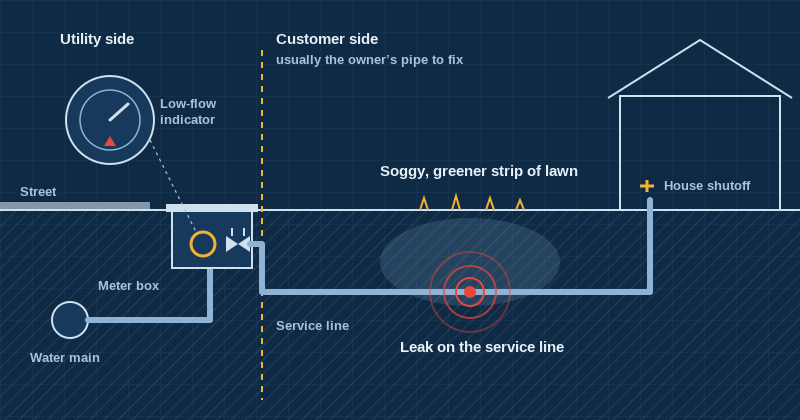
A service line leak in Temple is a leak in the buried pipe between the water meter and the house. A provider confirms it by closing the house shutoff and watching the meter, traces the line’s route, then listens along it or uses tracer gas to pinpoint the leak. In Temple’s expansive clay, leak water often collects in the meter box or follows the pipe trench rather than surfacing directly above the leak.
Signs of a service line leak in Temple
- The meter keeps moving after you close the house shutoff.
- The meter box fills with water when it hasn’t rained.
- A soft, sunken or greener strip runs between the meter and the house.
- Pressure dropped at every fixture at once.
- Hissing at the meter or where the line enters the house.
- A bill that climbed with no leak found inside the house.
What’s different about service line leaks in Temple
Houston Black clay, the most common soil in eastern Bell County according to the Handbook of Texas, is known for marked shrinking and swelling. Soil scientists describe it as a clay that develops deep cracks when dry. A buried water line in that soil lives through a lot of movement.
That shows up in a few ways:
- Joints and connections take the strain. The meter coupling, any repair couplings along the line and the point where the line turns up toward the house are where Temple service lines most often fail.
- Water goes where the soil lets it. Dense, wet clay drains slowly, so leak water tends to follow the looser backfill in the pipe trench. A flooded meter box or a wet spot near the house can be fed by a leak somewhere between them.
- Dry spells can hide a leak. When the clay shrinks and cracks in a long dry stretch, leak water can drain into the cracks and disappear. The meter keeps counting even when the yard looks fine.
- Shallow sections feel the weather most. Lines near the meter and where they rise to the house are closest to the surface and most exposed to both soil movement and freezing.
Common causes
- Shrink-swell movement pulling on couplings and fittings.
- Aging galvanized steel corroding from the inside.
- Older plastic lines becoming brittle.
- Damage from fence posts, landscaping or earlier repairs.
- Vehicle loads over lines that cross driveways.
- Freeze damage at shallow sections.
How service line leaks are found
- Isolation. The house shutoff is closed and checked for a full seal while the meter is watched.
- Irrigation check. Irrigation that branches before the house shutoff is isolated separately so it isn’t mistaken for the service line.
- Line tracing. Metal lines are traced electronically. Plastic lines are traced by tracer wire if one exists, or by sending a signal or transmitter through the line.
- Acoustic listening along the route at close intervals. In clay, the sound can be muffled, so readings are compared carefully.
- Tracer gas where listening isn’t conclusive or the pipe is plastic.
What the inspection involves
The provider needs access to the meter box, the house shutoff and the yard between them, including gates. Tell them if the line has ever been repaired, if foundation or landscaping work has been done near it, and whether the meter box has been flooding. Expect the route to be marked with flags or paint and the leak spot marked separately.
What happens after detection
A spot repair opens the ground at the marked point. A replacement runs a new line by trenching or boring under concrete. In moving clay, a line that has already failed at more than one joint is often a candidate for replacement. Ask about the backfill used in the repair, since it affects how the line handles future movement.
Before any digging, public utilities should be marked through Texas811. Your private service line won’t be marked, which is why the traced route matters.
When to call
Call when the meter moves with the house shut off, or when the meter box keeps filling with water. Call right away if water is bubbling up, the yard is sinking or pressure drops sharply. If the water is clearly coming from the street side of the meter, contact the water provider on your bill.
Frequently asked questions
Who is responsible for the line from the meter to my Temple home?
Typically the property owner, while the water provider handles the meter and the street side. Confirm with the provider on your bill.
Why is my yard dry if I have a leak?
In a dry spell, leak water can drain into shrinkage cracks or follow the pipe trench. The meter is a better guide than the lawn.
Why does my meter box keep filling with water?
It may be rain runoff, a leak at the meter connection, or a service line leak draining back along the trench. A meter test with the house shut off helps sort it out.
Should I replace instead of repair?
If the line is old or has leaked at more than one joint, replacement is often recommended. A single failure on a sound line is often repaired.
My home is outside Temple city limits. Does this still apply?
The detection process is the same. Your water may come from a water supply corporation, so check your bill for who handles the meter.
More leak detection in Temple
- Water leak detection in TempleThe Temple overview: local leak patterns, coverage and ZIP codes.
- Slab Leak Detection in TempleHouston Black clay, foundation movement and how slab leaks are located in Temple.
- How water service line leak detection worksThe full statewide guide: methods, costs and what to expect anywhere in Texas.
- Water Meter Leak DetectionUsing the meter to confirm a leak and narrow down where the water is going, including high-bill investigations.
- Underground Leak DetectionTracing and pinpointing leaks on buried lines across a property: yard lines, irrigation mains and lines to outbuildings.
Sources for the local details on this page
- Temple, TX ZIP code list and ZIP types
- Bell County ZIP codes (nearby communities)
- Bell County, Handbook of Texas (via TAMUCT library)
- Houston Black, the Texas state soil (Texas Water Development Board)
ZIP codes, nearby communities and soil notes come from the public sources above. Utility policies change, so confirm anything about billing or responsibility with your own water provider.