The short answer
A slab leak in a Bryan home is a leak in a water line running through the clay soil under the foundation. A provider confirms the loss at the meter, pressure-tests the hot and cold lines to find the leaking one, then pinpoints the spot from the floor with listening equipment, thermal imaging or tracer gas, so only a small section of floor has to come up for the repair.
Signs of a slab leak in Bryan
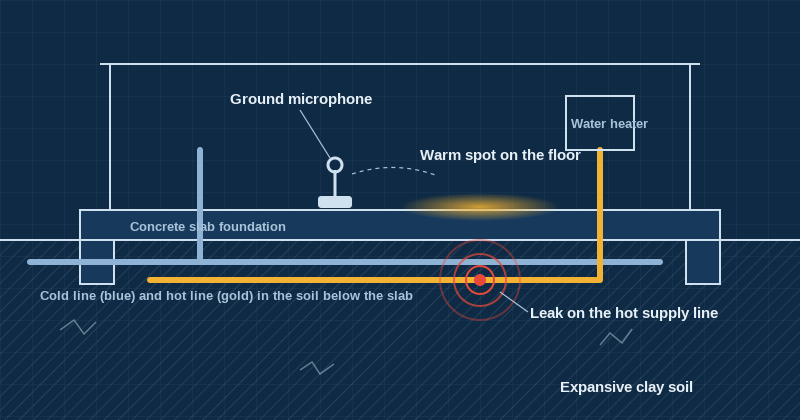
The classic signs apply here, with one local wrinkle: long, hot Brazos Valley afternoons warm floors near south- and west-facing windows. A sun-warmed floor cools off at night. A floor over a leaking hot water line doesn’t.
- A tile or concrete floor that’s warm in the same spot at night or early morning.
- A water heater running more often, or hot water running short.
- The sound of water moving under the floor with every fixture off.
- A bill that rose and stayed up, compared with the same month last year.
- Damp carpet pad, cupped wood or lifting vinyl away from any sink or tub.
- Water appearing at the edge of the slab or near where a line enters the house.
- A musty smell that seems to come from the floor.
What’s different about slab leaks in Bryan
Brazos County’s dark, loamy topsoil sits over clay subsoil, according to Texas A&M AgriLife, and the county straddles the Blackland Prairie and Post Oak Savannah. The clay is what matters under a slab. It drains slowly, shrinks when it dries and swells when it gets wet.
That affects slab leaks in three practical ways:
- Where the water goes. In slow-draining clay, leak water tends to stay close to the pipe or travel along the looser fill around it. It may surface at the slab edge, under a baseboard on the far side of a room, or not at all. A wet spot is a clue, not a location.
- Stress on the lines. Seasonal movement in the soil works on fittings and on the points where pipes rise through the concrete. Those are common leak locations.
- What a leak does to the soil. A steady leak keeps clay under one part of the slab wet while the rest dries. That uneven moisture is one reason to find a slab leak early rather than wait.
Bryan’s mix of housing also matters. Older homes near downtown may have copper or galvanized lines under the slab, while newer subdivisions are more likely to have plastic supply lines. Copper and galvanized pipe carry sound well and often suit acoustic listening. Plastic pipe is quieter and may call for tracer gas.
Common causes
- Hot line abrasion. Hot lines expand and contract with every use. Where they rub against concrete, gravel or another pipe, the wall wears thin.
- Pinhole corrosion in older copper, influenced by water chemistry and age.
- Fittings and rise points that take the strain of soil and slab movement.
- Construction damage such as a kinked or nicked line that fails years later.
- Polybutylene in homes built during the period it was widely used, roughly the late 1970s to mid-1990s.
How slab leaks are pinpointed
- Meter check with everything off, including irrigation.
- Hot and cold isolation. Each side is shut off and pressure-gauged. The one that loses pressure is leaking. A hot-side leak usually explains a warm floor and a busy water heater.
- Line tracing to map the leaking line’s route under the floor if it isn’t known.
- Acoustic listening with a ground microphone moved along the route. Escaping water is usually loudest above the leak.
- Thermal imaging to see the warm plume from a hot line spreading through the slab.
- Tracer gas for quiet leaks and plastic pipe.
What the inspection involves
The provider will start at the meter near the street and then go to the water heater, which in Bryan homes is often in the garage, a utility closet or the attic. They’ll ask you to keep water off while they test. Clear the floor over any warm or damp area, and make sure they can reach every bathroom and the kitchen.
Tell them about your flooring. Tile, wood, carpet and stained concrete all affect both detection and the repair plan.
What happens after detection
You’ll get a marked location and the repair options:
- Spot repair at the marked point, then restoring the slab and flooring.
- Reroute of the leaking line through walls or the attic, leaving the old section abandoned under the slab.
- Repipe of more of the system if there have been several leaks or the pipe material is a known problem.
If you’re also planning foundation repair, mention it. Some homeowners have the plumbing pressure-tested after leveling work to make sure the lines weren’t stressed.
When to call
Call when a warm spot lines up with a higher bill or a busy water heater, or when you hear water under the floor. Shut off the main and call right away if water is coming up through the floor.
Frequently asked questions
Are slab leaks more common in Bryan because of the clay?
Clay soil adds stress, but pipe age, material and installation are the bigger factors. The soil mostly affects where leak water goes and how a slab responds to it.
The warm spot is by a window. Is it a leak?
Check it at night or early in the morning. If it’s still warm when the sun can’t be the cause, and the water heater is running more, a hot line leak is worth testing for.
My Bryan home is fairly new. Can it have a slab leak?
Yes. Newer homes can have installation damage or failed fittings. Plastic lines are quieter, so tracer gas may be used to locate the leak.
Will they have to break up my whole floor?
No. Detection is done from the surface. The repair opens only the marked area, or avoids the slab entirely if the line is rerouted.
Who repairs the leak once it’s found?
Some leak detection providers repair; others hand the location to a plumber. Ask when you’re connected.
More leak detection in Bryan
- Water leak detection in BryanThe Bryan overview: local leak patterns, coverage and ZIP codes.
- Water Meter Leak Detection in BryanSorting a real leak from summer watering and billing questions with the meter.
- How slab leak detection worksThe full statewide guide: methods, costs and what to expect anywhere in Texas.
- Water Meter Leak DetectionUsing the meter to confirm a leak and narrow down where the water is going, including high-bill investigations.
- Water Service Line Leak DetectionFinding leaks on the buried pipe between the water meter and the house.
Sources for the local details on this page
- Bryan, TX ZIP code list and ZIP types
- ZIP 77802 overview with Census neighborhood names (Statistical Atlas)
- ZIP 77803 overview with Census neighborhood names (Statistical Atlas)
- Brazos County overview, Texas A&M AgriLife Extension
- USDA NRCS ecological site, Texas Claypan Area (includes Bryan)
ZIP codes, nearby communities and soil notes come from the public sources above. Utility policies change, so confirm anything about billing or responsibility with your own water provider.