The short answer
Leaks in Bryan homes are found the same way they are anywhere: confirm the loss at the meter, isolate the service line, hot side and cold side, then pinpoint the spot. What’s local is the ground. Clay subsoil that shrinks in dry spells and swells after rain puts steady stress on slab plumbing and buried lines, and it changes how and where leak water shows up.
Leak problems Bryan property owners run into
Texas A&M AgriLife describes Brazos County as mostly dark, loamy surface soils over clay subsoils, with part of the county in the Blackland Prairies and the rest in Post Oak Savannah. Federal soil scientists group Bryan and College Station into the Texas Claypan Area, and the clay soils along the river bottoms are rated high for shrink-swell, cracking as they dry.
That shapes the leaks people here deal with:
- Slab plumbing under strain. Most homes sit on concrete slabs over that clay. As the soil dries and rewets through the year, it moves under and around the lines beneath the slab, which adds wear at fittings and where pipes rise through the concrete.
- Leak water that doesn’t soak away. Clay drains slowly. Water from a buried leak can sit near the pipe, follow the looser fill around it, or show up at the slab edge or meter box instead of right above the leak.
- Summer bills that hide leaks. Irrigation use climbs in Brazos Valley summers. A real leak can blend into a bigger summer bill until someone checks the meter with the sprinklers off.
- A wide range of house ages. Bryan has established neighborhoods around downtown and the East Side Historical District alongside newer subdivisions such as Austin’s Colony and Copperfield. Older plumbing may include galvanized or early copper lines, while newer homes are more likely to have plastic supply pipe. Each fails in different ways and suits different detection methods.
- Rural edges. ZIP 77807 reaches into Robertson County and takes in the Lake Bryan area, where meters can sit far from the house and private lines run to shops and outbuildings.
Signs of a water leak in a Bryan home
- The meter’s low-flow indicator moves with the house and the sprinklers off.
- Your bill is higher than the same month last year without a change in watering.
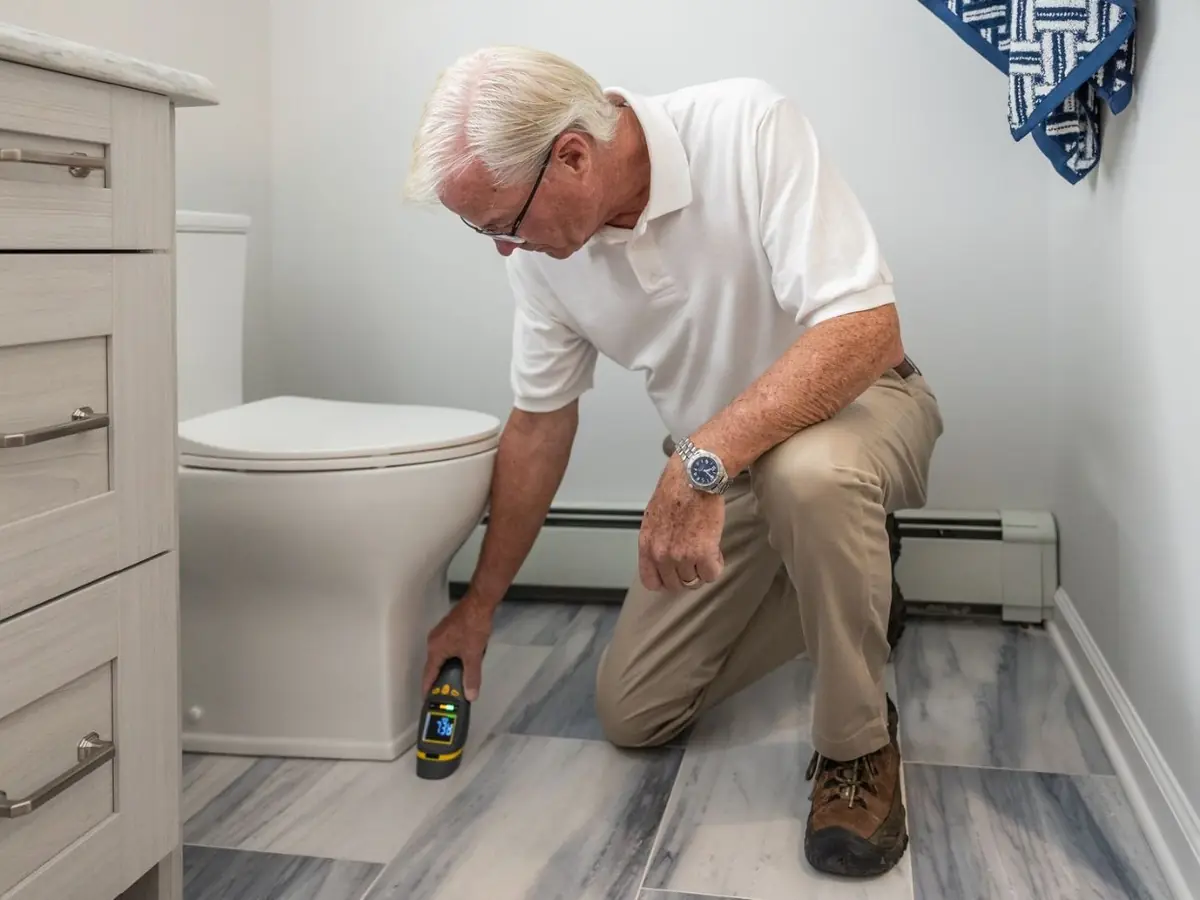
- A tile floor stays warm in one spot after dark, when the afternoon sun can’t explain it.
- The water heater cycles more than usual, or hot water runs out early.
- The meter box or a strip of lawn stays wet in a dry week.
- Baseboards swell or carpet feels damp with no fixture nearby.
- A ceiling stain appears below a second-floor bathroom or an attic air handler.
Leak detection services
These statewide guides explain how each type of leak is found. The methods are the same in Bryan; the local pages further down add what’s specific to the area.
- Slab Leak DetectionLocating supply-line leaks under a concrete foundation before anyone breaks the floor.
- Water Meter Leak DetectionUsing the meter to confirm a leak and narrow down where the water is going, including high-bill investigations.
- Water Service Line Leak DetectionFinding leaks on the buried pipe between the water meter and the house.
- Underground Leak DetectionTracing and pinpointing leaks on buried lines across a property: yard lines, irrigation mains and lines to outbuildings.
- Ceiling and Wall Leak DetectionTracking water stains and damp drywall back to the pipe, fixture or drain that is feeding them.
- Crawlspace Leak DetectionFinding leaks in the plumbing that runs beneath pier-and-beam homes.
- Commercial Leak DetectionLeak investigations for businesses, multifamily buildings and managed properties.
How leak detection works in Bryan
- Start at the meter. In most Bryan neighborhoods it’s in a box near the street. With everything off, including the irrigation controller, watch the low-flow indicator.
- Narrow it down. Close the house shutoff. If the meter still moves, the leak is likely on the buried service line or irrigation. If it stops, the leak is in the house.
- Test sections. A provider pressure-tests the hot and cold sides and any branch lines to find which one is losing water.
- Pinpoint. Acoustic listening, thermal imaging, line tracing or tracer gas locates the leak, which is marked on the floor or ground.
- Plan the repair. You get the location and the realistic options, from a spot repair to a reroute.
Want a professional to look at it? Call to request leak detection help in Bryan and talk through what you're seeing.
Call 1-866-297-0573Service coverage around Bryan
Calls are connected to local leak detection specialists who serve Bryan addresses, including neighborhoods such as:
- Downtown Bryan
- East Side Historical District
- Wonderland
- Briarcrest
- Austin’s Colony
- Tiffany Park
- Copperfield
- Lake Bryan area
Bryan shares a border and part of a ZIP code with College Station: ZIP 77845, which is mostly College Station, overlaps part of Bryan. If you’re in a nearby community, call and ask whether a provider covers your address.
Bryan ZIP codes
These are the standard delivery ZIP codes for Bryan addresses.
- 77801
- 77802
- 77803
- 77807
- 77808
PO Box ZIP codes 77805 and 77806 also belong to Bryan but have no street addresses, so they aren’t service locations on their own.
Specialized leak detection pages for Bryan
- Slab Leak Detection in BryanWarm tile, clay subsoil and how slab leaks are pinpointed in Bryan homes.
- Water Meter Leak Detection in BryanSorting a real leak from summer watering and billing questions with the meter.
Nearby cities with their own pages:
- Water leak detection in College Station, TXBrazos County, home of Texas A&M. A renter-majority city of student housing, duplexes and slab homes on clay.
- Water leak detection in Huntsville, TXWalker County seat, home to Sam Houston State. Wooded hills, sandy and clay soils, and a renter-majority housing market.
- Water leak detection in Waco, TXMcLennan County seat, on the Brazos River. Older homes, Baylor-area rentals and Blackland clay.
- All Central Texas and the Brazos Valley citiesEvery city in this region with its own page.
Bryan leak detection FAQ
Who do I contact about a leak at my water meter in Bryan?
If the leak is on the street side of the meter or at the meter itself, contact the water provider listed on your bill. If it’s on the house side, that’s usually your line to repair, and a leak detection provider can locate it.
Does Bryan’s clay soil cause leaks?
It’s one factor. Pipe age, material and installation matter most, but soil that shrinks and swells through the year adds stress to slab plumbing and buried lines.
My bill always goes up in summer. How do I tell if it’s a leak?
Compare it with the same month last year, then do a meter test with the irrigation controller off. If the meter moves with nothing running, it’s a leak, not just watering.
I live near Lake Bryan, outside the city. Does anything change?
Your water may come from a different provider, so check your bill. The detection methods are the same, though longer service lines and private lines to outbuildings can make tracing a bigger part of the job.
Do Bryan leak detection providers also do the repair?
Some do and some locate only. Ask when you’re connected so you know what the visit covers.
Sources for the local details on this page
- Bryan, TX ZIP code list and ZIP types
- ZIP 77802 overview with Census neighborhood names (Statistical Atlas)
- ZIP 77803 overview with Census neighborhood names (Statistical Atlas)
- Brazos County overview, Texas A&M AgriLife Extension
- USDA NRCS ecological site, Texas Claypan Area (includes Bryan)
ZIP codes, nearby communities and soil notes come from the public sources above. Utility policies change, so confirm anything about billing or responsibility with your own water provider.