The short answer
A slab leak in Victoria is a leak in a water line under a concrete foundation, set in clay-rich coastal-plain soil. A provider confirms water loss at the meter, isolates and pressure-tests the hot and cold lines, then pinpoints the leak from the floor using listening equipment, thermal imaging or tracer gas. A meter check after any storm or water outage can catch slab leaks early.
Signs of a slab leak in Victoria
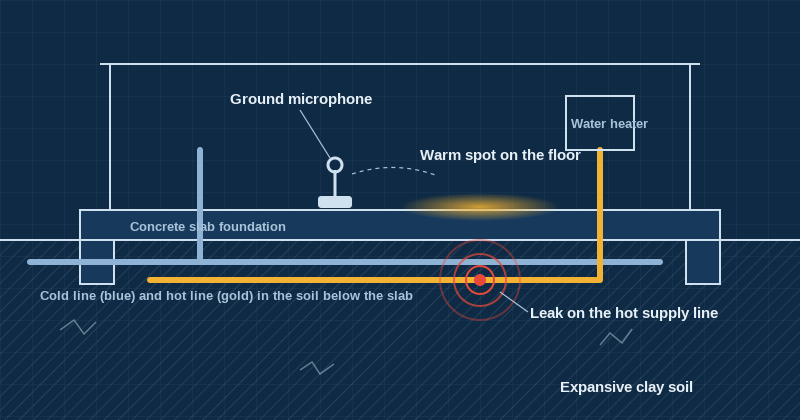
- A warm spot on a tile floor that’s still warm overnight.
- A water heater that runs more often, or hot water that runs out early.
- The sound of water under the floor with everything off.
- A bill that went up after a storm or outage and stayed up.
- Damp carpet, swollen baseboards or loose tile away from any fixture.
- Water seeping at the slab edge when it hasn’t rained.
What’s different about slab leaks in Victoria
Deep, heavy clay. The USDA describes the Victoria soil series as very deep, very slowly permeable clay formed in old delta and marine sediments, with clay contents commonly between about 40 and 65 percent. Soils this rich in clay shrink in dry spells and swell when wet, and the lines under a slab move with them. Fittings and the points where lines rise through the concrete are where that stress concentrates.
Very slow drainage. Water escaping under a slab into dense clay doesn’t drain away quickly. It can stay near the leak, keeping that part of the soil wetter than the rest, or travel along the looser fill around the pipe and show up at the slab edge some distance away.
Storms and outages. When water service shuts down and comes back, as it did across Victoria after Hurricane Harvey in 2017, pressure returning to the system can reveal fittings that were already weak. A quick meter test after service is restored can catch a slab leak before it shows anywhere else.
Flood water is a different problem. If water entered the house from outside during a flood, wet floors and baseboards may have nothing to do with the plumbing. A meter test separates the two, which matters for both the repair and the insurance claim.
Common causes
- Soil movement stressing fittings and rise points.
- Hot line abrasion from expansion and contraction.
- Pinhole corrosion in older copper.
- Construction damage that fails years later.
- Known problem materials such as polybutylene in homes from that era.
- Pressure surges when water service is restored.
How slab leaks are pinpointed in Victoria
- Meter test, first with everything off and then with the house shutoff closed.
- Hot and cold isolation with gauges to find the leaking side.
- Line tracing to map the leaking line under the slab.
- Acoustic listening along the route. In dense clay, the sound can be muffled, so close spacing helps.
- Thermal imaging on hot-side leaks.
- Tracer gas for quiet leaks and plastic pipe.
What the inspection involves
The provider will start at the meter, then check the water heater and main shutoff before testing. Clear floor space over warm or damp areas. If the house took on flood water in the past, mention it, along with any foundation repair, because both affect how the readings are interpreted.
What happens after detection
Repair options include a spot repair at the marked location, a reroute through walls or the attic, or a repipe if there have been several leaks. Rerouting can make sense when lines sit in clay that keeps moving. Keep invoices and photos, especially if you’re filing an insurance claim.
When to call
Call when the meter moves with everything off and the house shutoff stops it, or when a warm floor lines up with a higher bill. After a storm or outage, call if the meter shows a new leak. Shut off the main and call right away if water comes up through the floor.
Frequently asked questions
Should I check for a slab leak after a hurricane or outage?
It’s a good idea. Once water service is back, do a meter test with everything off. A new leak can show up when pressure returns.
My floors got wet in a flood. Could it be a slab leak?
Flood water and slab leaks look alike on the floor. A meter test with everything off tells you whether the plumbing is leaking.
Does Victoria’s clay make slab leaks more likely?
It adds stress through shrinking and swelling, but pipe age and material are also major factors.
Why is the wet spot far from where the leak was marked?
In dense clay, water often follows the looser fill around the pipe and appears some distance from the leak.
Will my insurance cover a slab leak?
Many policies cover resulting water damage and some cover access, but not the pipe itself. Flood damage needs separate flood coverage.
More leak detection in Victoria
- Water leak detection in VictoriaThe Victoria overview: local leak patterns, coverage and ZIP codes.
- Ceiling and Wall Leak Detection in VictoriaRoof, attic AC or plumbing? Sorting out ceiling stains after Gulf storms.
- How slab leak detection worksThe full statewide guide: methods, costs and what to expect anywhere in Texas.
- Water Meter Leak DetectionUsing the meter to confirm a leak and narrow down where the water is going, including high-bill investigations.
- Water Service Line Leak DetectionFinding leaks on the buried pipe between the water meter and the house.
Sources for the local details on this page
- Victoria, TX ZIP code list and ZIP types
- ZIP 77904 details: land area (zip-codes.com)
- ZIP codes of Victoria County (nearby communities)
- Victoria soil series, USDA official series description
- Victoria council review of Hurricane Harvey and the water system (Victoria Advocate via GovTech)
- Victoria boil-water order after Harvey (KSAT)
ZIP codes, nearby communities and soil notes come from the public sources above. Utility policies change, so confirm anything about billing or responsibility with your own water provider.